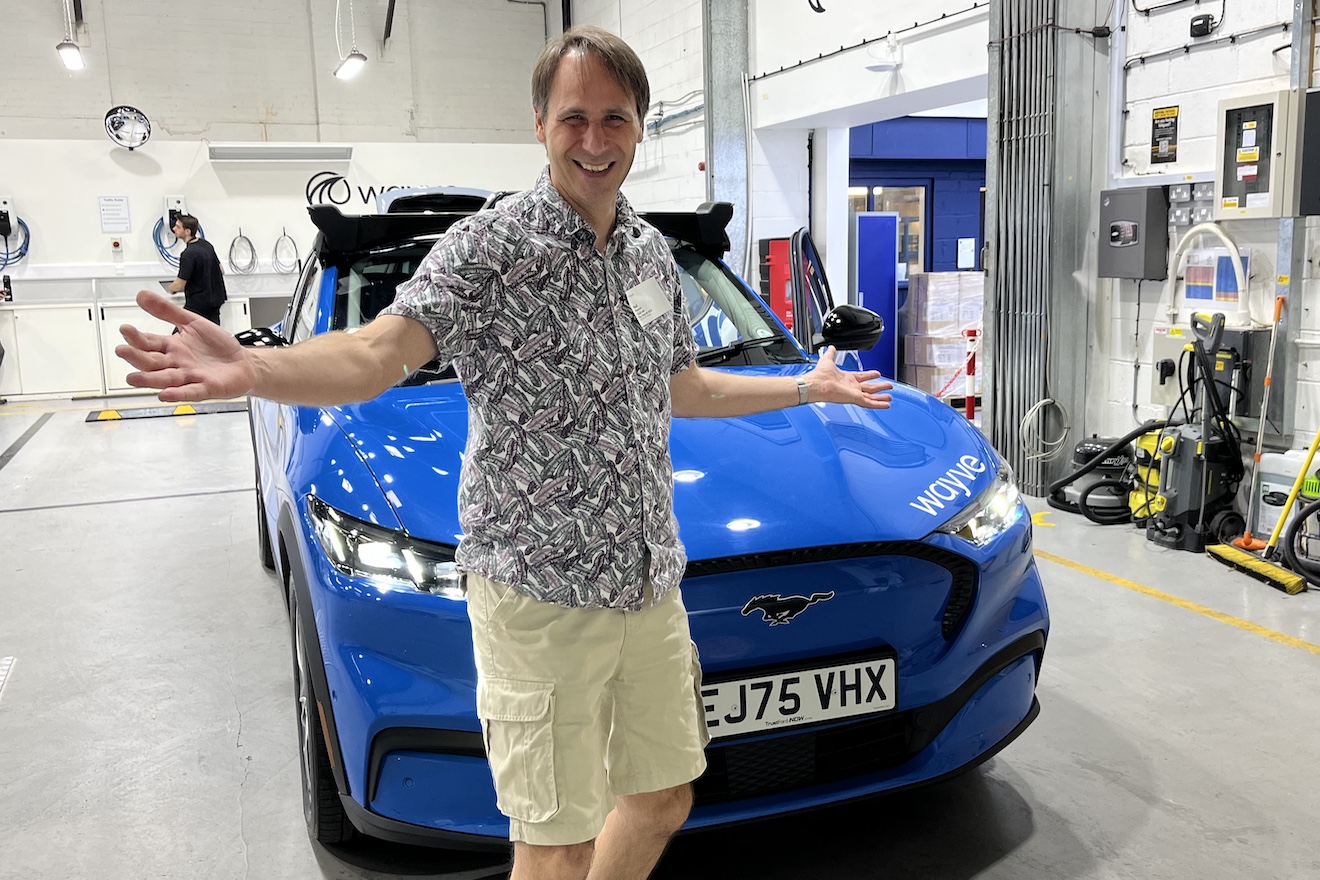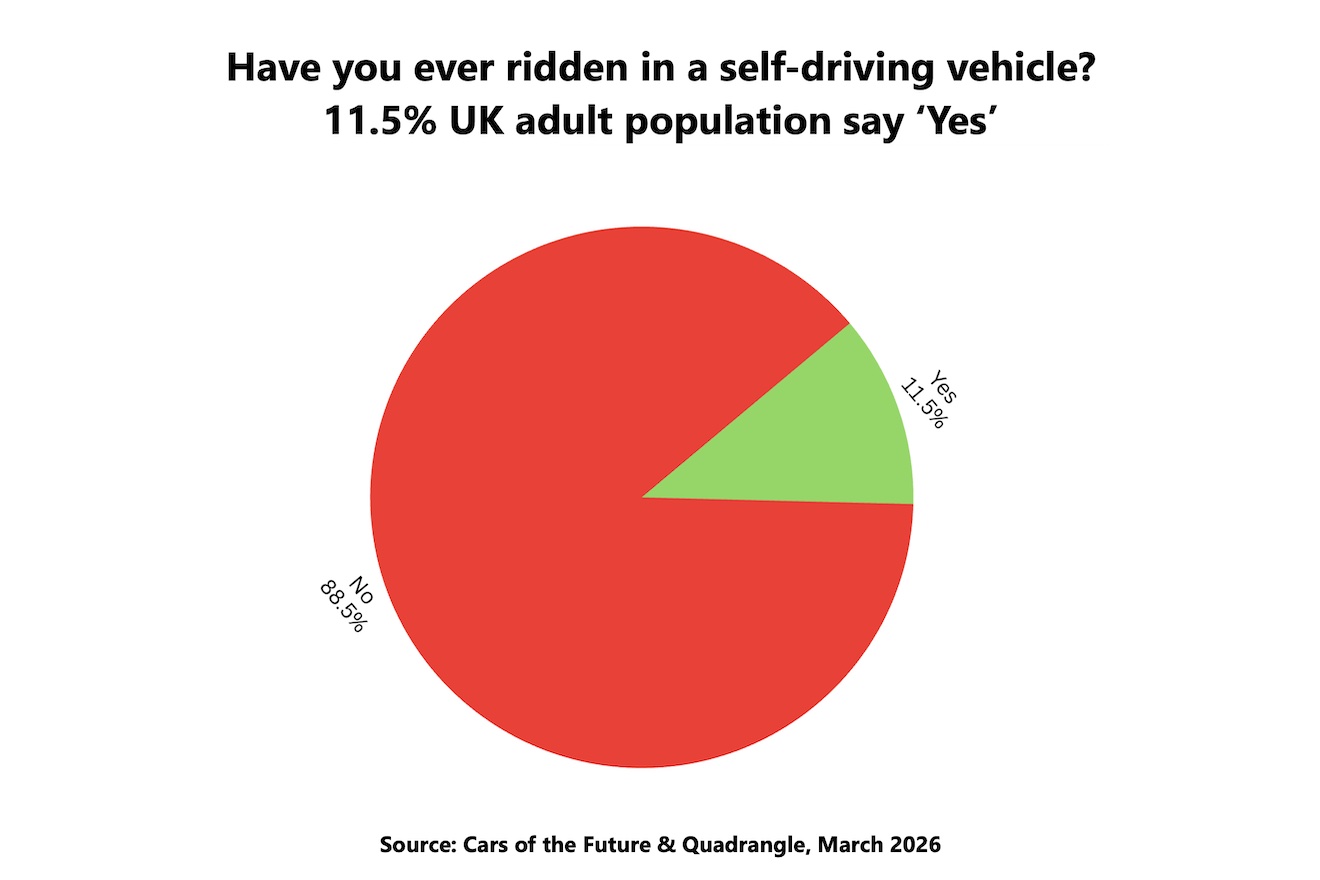

Cars Of The Future gets an exclusive tour of the most advanced commercial autonomous vehicle deployment in the UK, perhaps in Europe – by Westwell at Port of Felixstowe in Suffolk.
In England, it’s still ok to get excited at the sight of a self-driving vehicle. Here, within minutes of being on-site, you quickly become rather blasé about it. These automated heavy goods vehicles (A-HGVs) are big, they’re clearly Level 4 (having no driver’s cab), and they’re everywhere you look, just going about their everyday tasks.
Let’s rewind slightly. Located on the North Sea, roughly opposite Rotterdam, the Port of Felixstowe is Britain’s busiest container port. Owned and operated by Hutchison Ports, the world’s leading port network, it is 3.5km from end-to-end, has three rail terminals, four deep water berths for ‘mega vessels’, and handles four million TEUs a year.
TEU stands for Twenty-foot (20ft) Equivalent Units, the standard maritime measurement of cargo capacity, and 4m is an awful lot. Loading and unloading shipping containers is dangerous and repetitive work, it’s also off-highway, so a perfect early automation use case.
Back in 2022, a delegation including Senior Manager for Programme Delivery & Efficiency at Port of Felixstowe, Aaron Cavanagh, visited another Hutchison container terminal, Laem Chabang Port in Thailand, where they were running six Shanghai Westwell Technology ATs.
Building on previous experience leading and contributing across multiple innovation areas, including infrastructure and energy (rail electrification), digital connectivity (private 5G network deployment), and automation and data, the team immediately recognised the potential of this technology and initiated a feasibility study. This assessed the technical, operational, and safety requirements necessary to enable effective and safe deployment at the Port of Felixstowe.
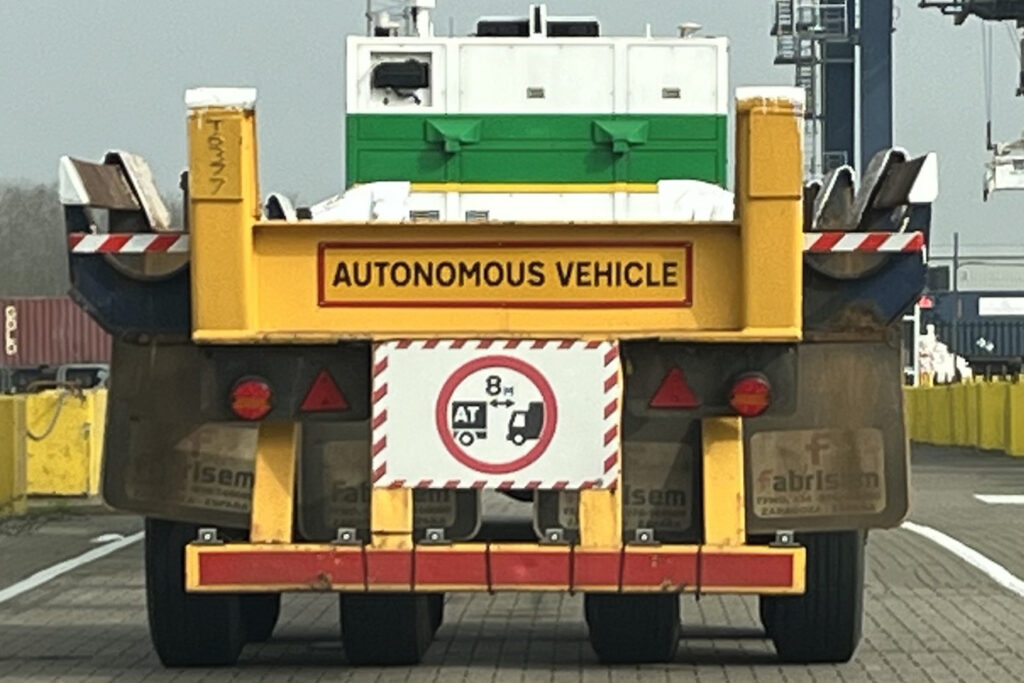
Within a year, the Port had ordered 100 of Westwell’s battery-powered autonomous Q-Trucks. Announcing the deal, Clemence Cheng, CEO of the Port of Felixstowe, said: “We are really excited to be working in partnership with Westwell to bring their ground-breaking technology to the UK. The new trucks will increase the efficiency of our container handling, as well as making a significant contribution to decarbonising operations at the port.”
Kenny Tan, Chairman of Westwell, added: “Hutchison Ports is a significant global partner. As a world-leading company in intelligent mass logistics, Westwell can help increase efficiency while reducing costs and delivering sustainable development options. The contract also marks a very important development of Westwell’s Ainergy Strategy to utilise AI applications to reduce energy consumption.”
Autonomous trucks arrive in UK
The first trucks arrived in September 2023, but Cavanagh was quick to point out that the vehicles themselves are only part of the package. For starters, he had a new colleague – former teacher and fluent Chinese speaker, Benjamin Gaunt, Senior Project Manager at Westwell.
Together, teams from both respective parties made astonishing progress. First, ensuring that all relevant safety standards were met, liaising with unions and the Port Users’ Association, then gradually scaling from dedicated lanes to mixed traffic, constantly raising the resilience of their model.
The result is something to behold. 34 autonomous electric trucks working 24/7. 34 more ATs will join the fleet soon; 14 are already on-site being tested and commissioned. “We provide the full stack – the Fleet Management System (FMS), the AV software, hardware, and implementation,” said Gaunt.
Addressing the Zenzic CAM Innovators event, he expanded on the key challenges: “At the outset, we made the reasonable assumption that the system, being proven, would be almost plug and play. That was wrong, but what made it hard wasn’t the technology, it was everything else – the legacy infrastructure designed for human drivers, the lack of standards defining safety, the people with limited understanding and sometimes mistrust of driverless.
“We made it work by building a focused use case – a minimum viable product for our own operational needs – then scaling. We accepted that we were managing risk, not eliminating it completely. We treated safety as a system, questioned all the existing processes, and embraced continuous learning.”
The final essential element was a commitment to education and transparency. “Engaging early with everyone who comes into contact with the ATs definitely helps to build trust, but you have to be proactive about it,” he advised.
Automated battery change
Let’s get back to the tour. It is often claimed that CAM has net zero (NZ) benefits baked in. The battery switching station at Port of Felixstowe provides impressive real-world evidence.
Day or night, the autonomous trucks drive up to a covered controlled safe area containing a machine which looks a bit like a carwash. A robotic arm takes out the spent CATL battery pack and slides in a fully charged one. The truck then drives itself back into service, in six minutes flat, potentially without a human in sight. Absolute gamechanger!
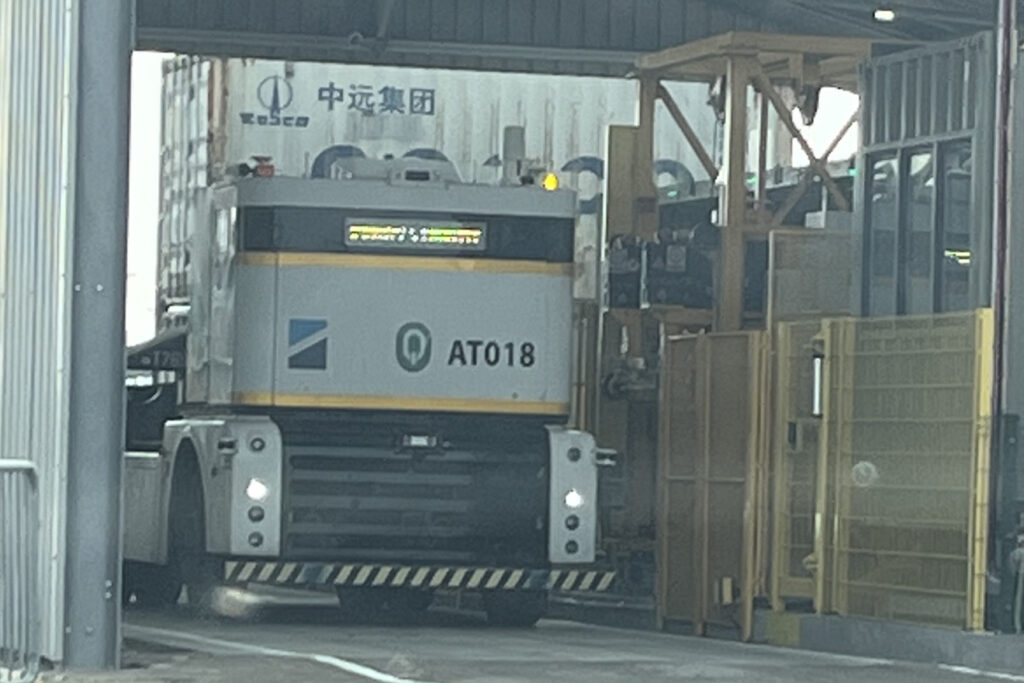
At the quayside, some human intervention is sometimes required to support the autonomous technology when dealing with edge cases. Over time, these exceptional events have become less frequent. The trucks work in full mixed mode with human operators who conduct removal of twist locks at designated safe fenced-off stations away from working quay crane operations.
The six‑minute automated battery change compares extremely favourably with manual replacement, which typically takes around 90 minutes to two hours, as well as with round trips to a fuel bowser for diesel refuelling.
“The time savings alone are significant, even before accounting for the emissions benefits,” says Gaunt. “We benchmark autonomous truck performance directly against human‑driven trucks and are seeing consistently positive results. Operational performance is monitored through geofenced areas and GPS‑based cycle‑time tracking, enabling like‑for‑like comparison against manual truck cycle times.
“The autonomous trucks operate strictly to the rules defined within the FMS, with speed limits embedded into mapped geofenced zones, typically 10mph beneath quay cranes and up to 20mph on main transfer roadways.
“We have carried out extensive safety validation across a wide range of operating conditions, including adverse weather, using both simulation and live on‑site testing. The FMS incorporates high‑fidelity 3D mapping, allowing us to model the operating environment precisely and continuously improve vehicle performance as conditions change.
“Detection performance has been progressively enhanced to normalise the effects of adverse weather through ongoing refinement of perception algorithms and iterative training against real‑world operational data.”
Best practice
The autonomous fleet has recently been upgraded from 32‑line to 128‑line LiDAR, significantly improving resolution and effective detection range, alongside the addition of downward‑facing dome LiDAR to enhance close‑proximity coverage.
Each vehicle is equipped with binocular and stereo camera systems providing full 360‑degree vision, eliminating blind spots, and ultrasonic sensors are fitted to the rear of trailers to support close‑range pedestrian detection during reversing manoeuvres.
Gaunt continues: “The vehicles are fully compliant with applicable ISO standards and have been subject to rigorous testing using test cases that replicate real operational scenarios. The FMS optimises routing in real-time, while the Terminal Operating System (TOS) schedules and sequences work instructions.
“One of the more complex challenges is operating safely and efficiently in mixed‑traffic environments, particularly at junctions where autonomous and human‑driven vehicles interact. To address this, junction logic continues to evolve to better reflect human driving behaviour, improving predictability and traffic flow. Our autonomous cabs use multiple visual indicators to communicate intent, and all human drivers entering the operating area are briefed on defined interaction and driving rules.
“In the event of a vehicle fault, trucks can be safely recovered or manoeuvred using a remote handheld control, although such interventions are infrequent. Stepping back, the task itself is straightforward – moving a container from A to B as efficiently as possible.
“In doing so we have developed a substantial body of best practice in safety, systems integration, and operational control, which we believe could support the UK’s wider ambition to be a global leader in autonomous transport technologies.”