Another year, another excellent Connected and Automated Mobility (CAM) Innovators’ Day at The Institution of Engineering and Technology in London.
Opening the event, Zenzic Programme Director, Mark Cracknell, reminded delegates that the organisation’s CAM Roadmap predicted almost a decade ago that “2026 would be a pivotal year”. So it appears, with increasing evidence of, in Cracknell’s words, “a huge uptick in CAM technologies”.
There followed probably the most eloquent Ministerial keynote we’ve ever heard on self-driving. Chris McDonald MP, UK Minister for Industry across the Department for Business and Trade (DBT) and the Department for Energy Security and Net Zero (DESNZ), a chemical engineer by trade, promised “commercial pilots later this year”, with multiple homegrown companies more than ready “to move from trial to product”.
He cited the award-winning Enviro100AEV bus by Alexander Dennis and Fusion Processing, the British Business Bank’s £25m investment in Wayve (part of its recent $1.2bn funding round), the National Wealth Fund’s US$50m investment in Oxa, and Aurrigo’s newly announced £6.3m contract with Ultra Global Limited to supply 25 autonomous guided vehicles (AGVs).
Reflecting on the nature of innovation – that nascent technologies fail and fail again before succeeding – McDonald said: “It is essential we have these innovations here in the UK and self-driving is one of those opportunities.”
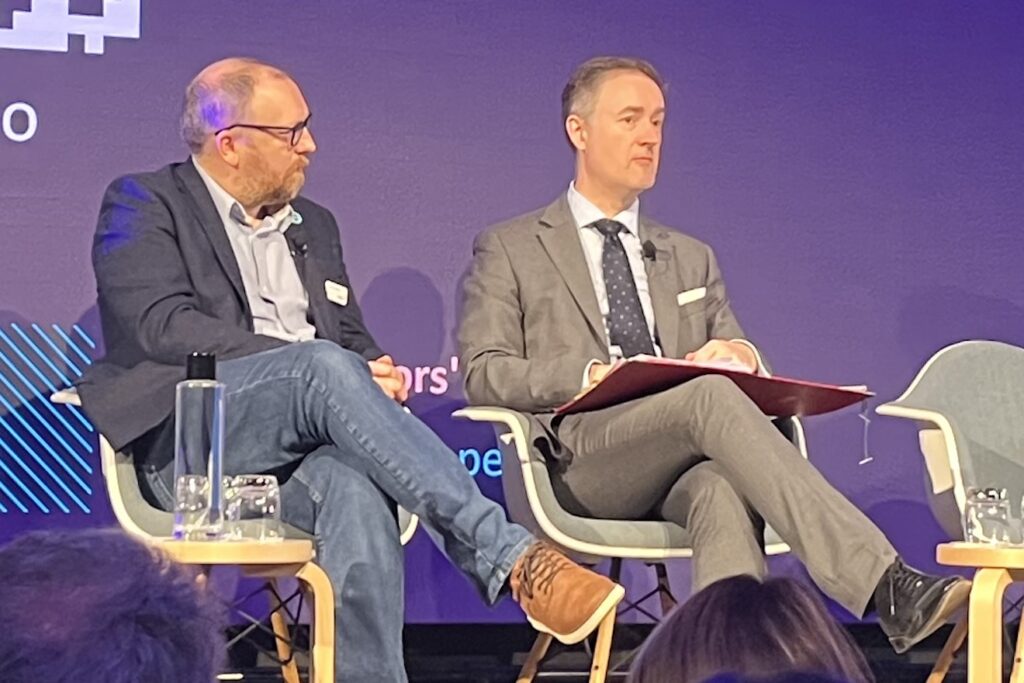
Like many before him, McDonald highlighted the Society of Motor Manufacturers and Traders (SMMT) forecast that self-driving could add £66bn to the UK economy and create 342,000 jobs by 2040.
In general, though, he appeared more informed than his predecessors, and was certainly more generous with his time, joining Cracknell for a wide-ranging one-to-one discussion covering everything from robotaxis to “closed environment” opportunities at ports, airports and campuses.
Cracknell noted that London will see major robotaxi players from the US and China going head-to-head with UK operators, with McDonald asserting there is “clear demand” for this.
The public are enthusiastic but “we need to create market acceptance” to avoid “the potential issue of resistance”, he said, adding that “dual use” technologies, with both “civil and defence” applications, could help to attract investment.
Indeed, some early Self-Driving Industry Award winners have already pivoted that way, particularly in the drone and cybersecurity sectors.
Google Cloud
The bar remained high as the job of following the Minister fell to Chacasta Pritlove, Head of Public Sector – Transport at Google Cloud.
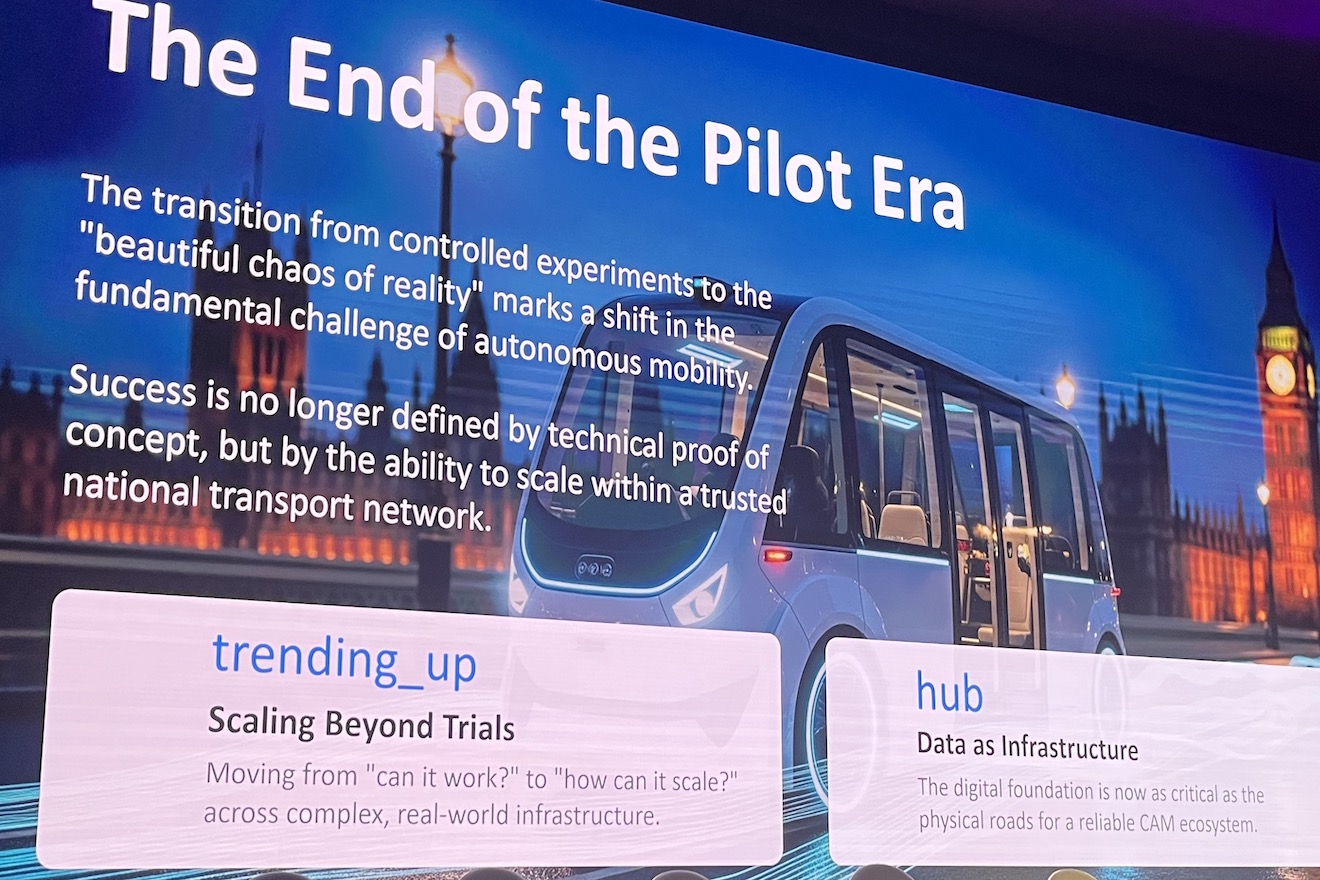
The question is no longer ‘Can it work?’, but ‘How does it become trusted?’, she said, suggesting that, in the event of crashes, an “immutable black box will be a fundamental requirement for public trust”.
Given that each connected car with radar and lidar will generate around 16 terabytes (Tb) of data a day, all being processed in near real-time, Google is working with the Department for Transport (DfT) on two key pillars: 1) Providing security and sovereignty in UK computing, and 2) Providing real-time intelligence to improve transport efficiency.
The former involved the first, but not the last, mention of borders – the need to process data close to home to maximise both technological security and societal benefits. An alluring example of the latter was using telematics to monitor changes in road integrity, enabling pre-emptive resurfacing before potholes even occur.
“Transport in rural areas is a massive issue,” said Pritlove. “We must solve this to grow our economies.”
Responding to a question from the audience as to which other sectors demand similarly high-powered computing, she pointed to weather forecasting and protein research as both requiring zettabytes… that’s a trillion gigabytes.
Mass Mobility
After Cracknell set out the UK’s strengths in software, automation, testing and safety, and provided a brief update on CAM Pathfinder, we were introduced to Pierre Delaigue, of French highways specialist VINCI, who set the scene for the first panel of the day, on serving the public through CAM.
For the uninitiated, VINCI is a huge global operator with 300,000 employees. It designs, build and operates roads around the world.
Delaigue noted how leading passenger vehicle manufacturers such as Mercedes and BMW were stepping back from developing Level 3 conditionally automated driving systems to focus on Level 2, leaving Honda as the frontrunner in L3.
He also highlighted that there are currently only around 10,000 robotaxis in the world, mainly in the US and China (representing about 0.03% of all taxis), and around 7,000 automated shuttles, mainly in Europe. “We at VINCI are focussed on mass mobility,” he said, tellingly.
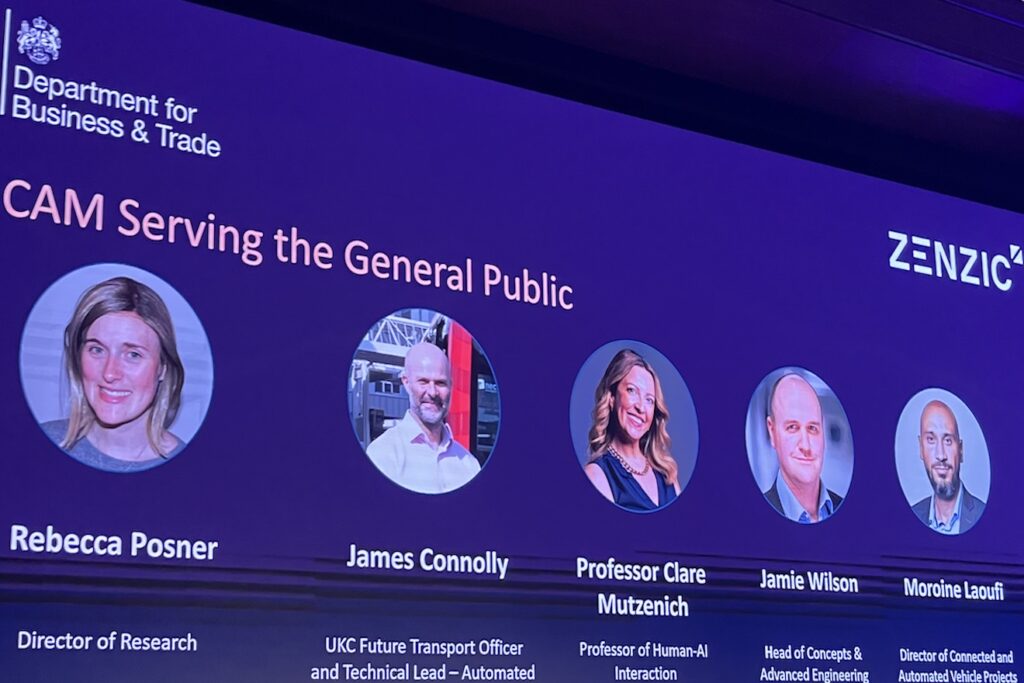
So to the panel, hosted by our inaugural Self-Driving Consumer Champion, Rebecca Posner, now of the Research Institute for Disabled Consumers (RiDC), and featuring VINCI’s Moroine Laoufi, James Connolly of Solihull Metropolitan Borough Council, our 2024 Research award winner, Professor Clare Mutzenich, and Jamie Wilson, of Alexander Dennis, a driving force behind our reigning Self-Driving Vehicle of the Year, the aforementioned Enviro100AEV bus.
There was passionate advocacy for clean, resilient, sovereign public transport, over single occupancy vehicles. Commenting on the Automated Vehicles (AV) Act, Wilson said: “This isn’t red tape, it’s fundamental safety assurance.”
Embedding CAM
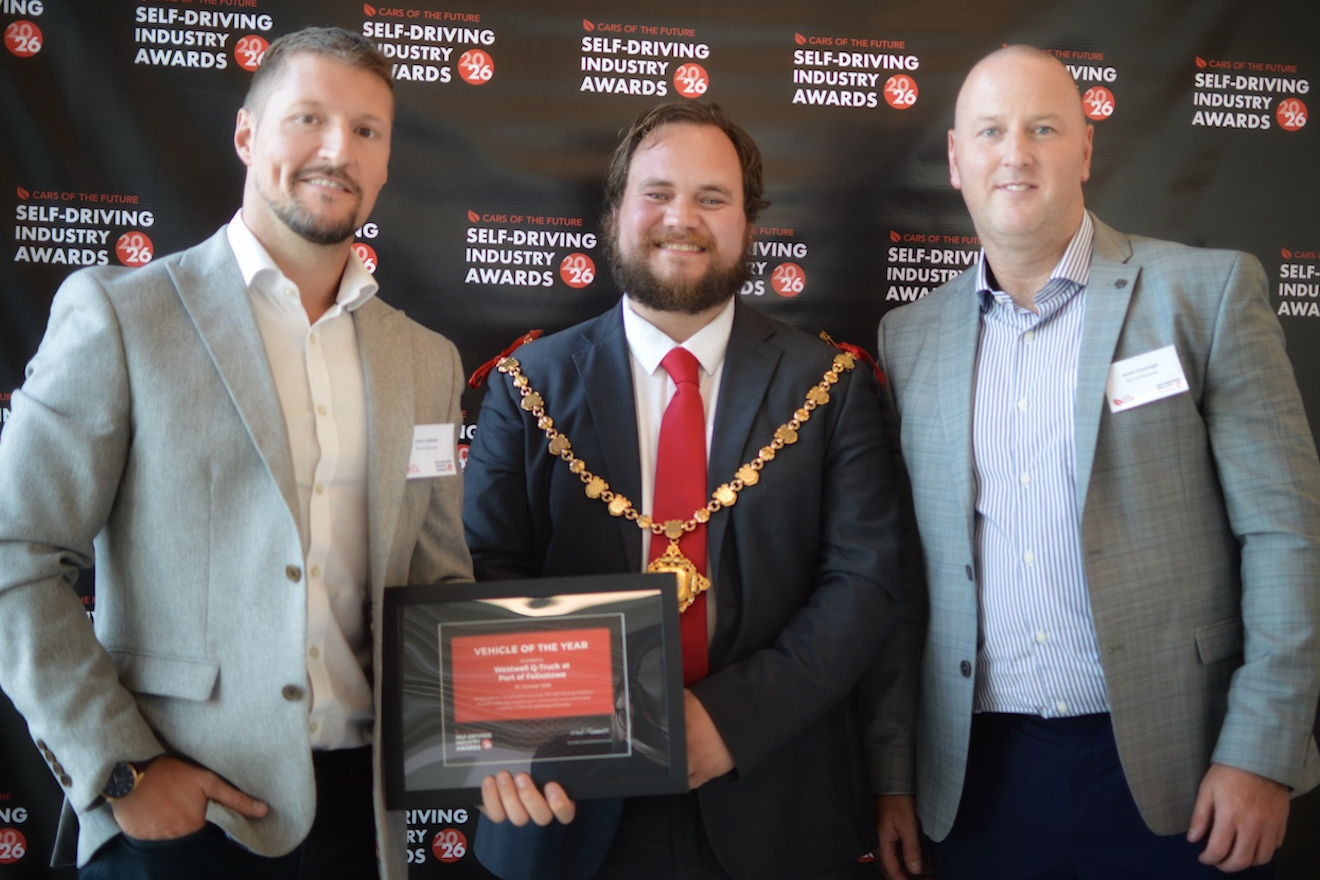
After a short break, our attention turned to embedding CAM in near markets. First up was Benjamin Gaunt, Project Manager at Westwell, who detailed their deployment of 34 autonomous trucks (ATs) in mixed traffic at Port of Felixstowe in Suffolk.
We’ll bring you an in-depth feature on that very soon. Safe to say, it is, as Gaunt said: “A brilliant use case – the most advanced live AV deployment in the UK, possibly in Europe.”
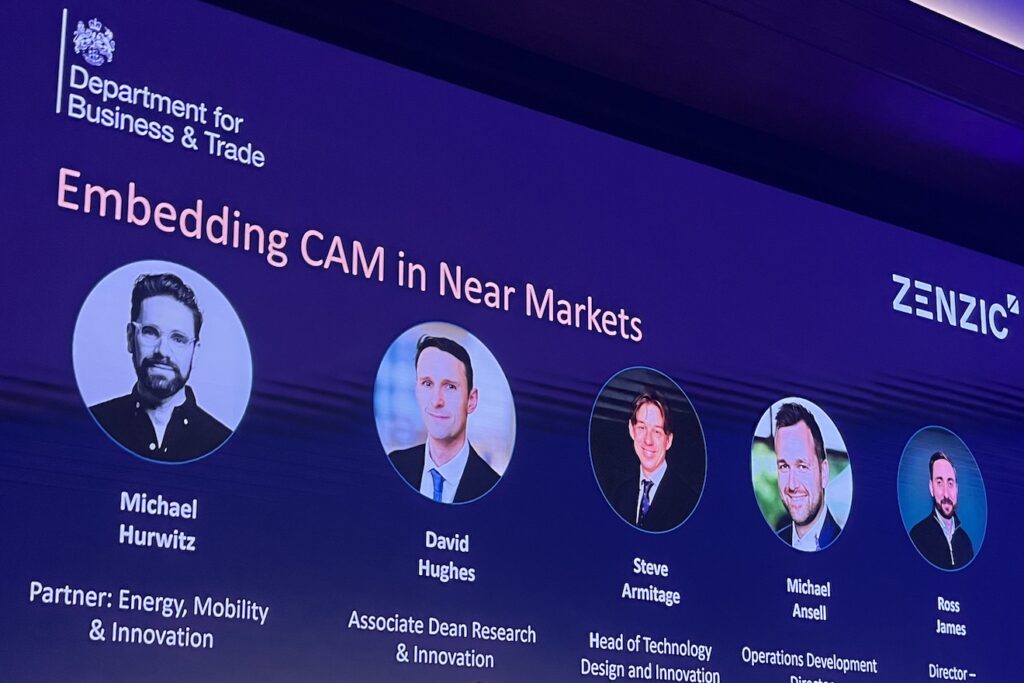
The next panel, expertly moderated by Michael Hurwitz of PA Consulting, featured David Hughes of Teesside University, Head of Technology at Heathrow, Steve Armitage, Michael Ansell of DHL, and Ross James of Oxa.
A live audience poll indicated that operational and regulatory challenges were now the most difficult, rather than technological issues.
Citing sky-high Bank of America predictions on the value of the AV opportunity, the panel naturally focussed on the DHL and Oxa trial at Heathrow. Armitage outlined the airport’s near-term ambition to move to L4 trials, saying: “It’s not 100% safe, but it is safer.”
James pointed to requirements under the EU’s Machinery Directive, and Ansell talked of productisation and scaling. Using the example of efficiency gains in transporting fresh fruit, where faster delivery means higher profits, Hughes highlighted potential benefits for SMEs worldwide.
Smoothly filling the last speaking spot before lunch, a star performer from CAM Innovators 2025, Mike Dawson of Belfast Harbour, reported that the Harlander shuttle was very popular with the public. “People ask us when it is coming back,” he said.
Building the CASTLE
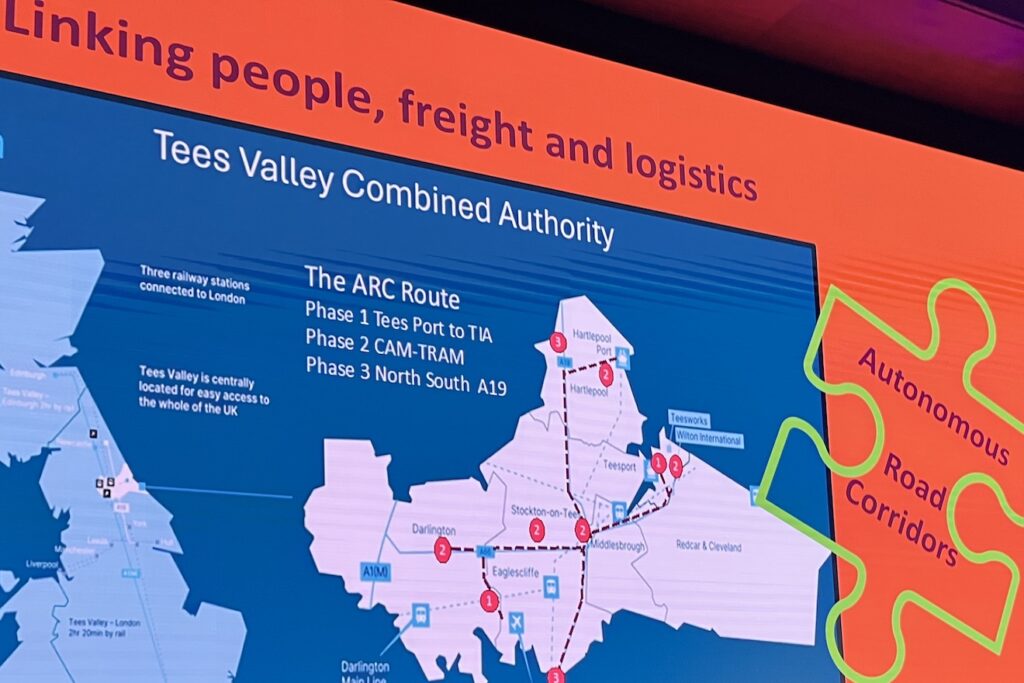
After lunch, attention turned to setting CAM on a growth trajectory. Andrea Reacroft, of Tees Valley Combined Authority, won the prize for best acronym for their CASTLE initiative – the connected, automated, strategic, Teeside logistics ecosystem. The plan is to develop “autonomous road corridors” across the region, then across the UK.
Reacroft then joined a high-profile panel, hosted by Catherine Whitfield, now of Mott Macdonald, and featuring Joyce Achampong of Imeche (organiser of the Formula Student engineering skills competition), Jamie Hodsdon of Waymo, Tim Edwards of Jaguar Land Rover (JLR), and Josh Robson of the ScaleUp Institute.
“Internationally, the UK is still ahead,” said Hodsdon. “We’re confident we can deliver safety improvements in London as we have done on roads with similar traffic density and speeds in the US. There, people try our service, like it and start using it.”
Addressing the role of existing passenger cars, Edwards said a key aim should be to maximise the benefits of digital technologies ahead of full automation.
Self-Driving Leaders
Ahead of the final panel of the day – featuring Zenzic’s Alex Wood, Miles Garner of Aurrigo, and our reigning Self-Driving Industry Legend, the DBT’s Michael Talbot – there was an info-packed remote presentation on off-highway opportunities by Corey Clothier of Aribo.
In particular, he highlighted a plethora of great airport use cases, from cargo and luggage moving to grass mowing and Foreign Object Debris (FOD) detection and removal, the latter being a critical aviation safety hazard which costs the industry billions of dollars every year.
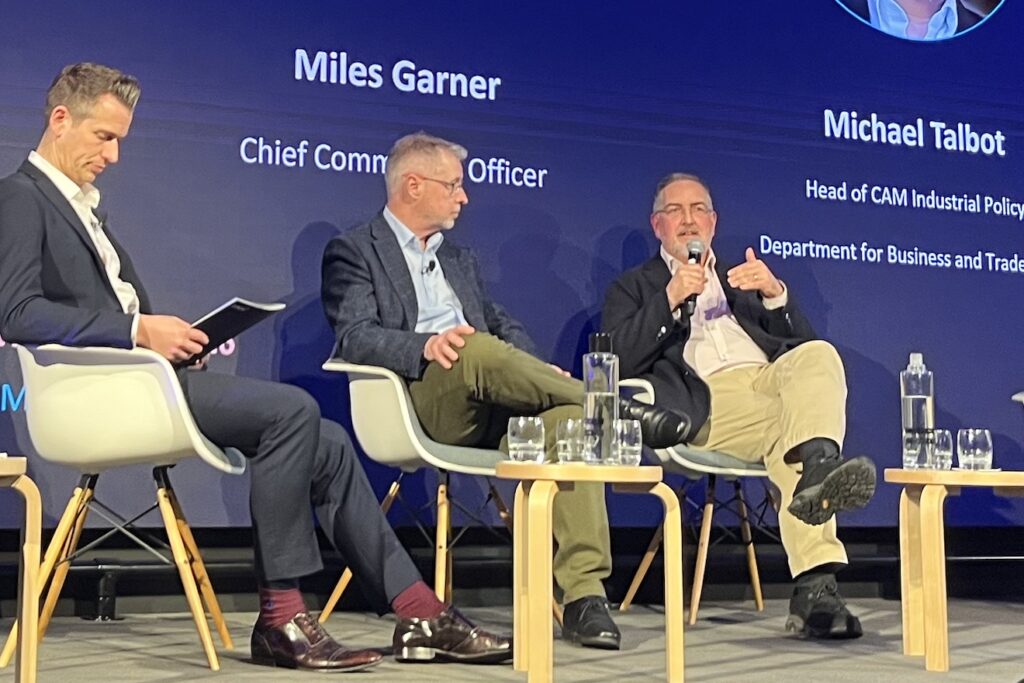
Suddenly, the end was nigh. Garner reflected on the importance of Aurrigo recently securing approval from the UK Civil Aviation Authority (CAA), and the challenge of bringing together all the important players in the supply chain – not only the airports and airlines, but all the associated service providers.
Looking ahead to the ITS World Congress in Birmingham next year, Talbot reiterated the need to ensure that the AV Act is fully and swiftly implemented. He pointed to the recent Memorandum of Understanding with South Korea’s Autonomous Driving Development Innovation Foundation (KADIF) as an example of increasing co-operation with like-minded countries.
The official proceedings over, we adjourned for post-event refreshments to mull the big questions of the day: Is there actually any evidence of consumer demand for robotaxis in London? Will Waymo or anyone else really be operating commercial services here by the end of the year? Should you accept a computer’s decision-making without seeing its workings-out? Did anyone have two of the beetroot vol-au-vents?
Over the coming months, our beautifully redesigned Cars Of The Future website will explore at least some of these pressing self-driving issues.