
Having got the UK perspective on self-driving at CAM Innovators the week before, on 19 March we got the continental view at the European AV Summit 2026.
Utilising the impressive Sustainable Ventures space at London’s County Hall, 200+ delegates from 27 nations gathered to hear 40+ experts discussing a full gamut of key industry issues – private ownership, fleet and logistics, safety, accessibility, insurance, public acceptance and more.
It was an action-packed event, a different crowd to the usual UK faces. Here are our extended highlights…
Setting the tone, Lukas Neckermann, of Neckermann Strategic Advisors, targeted us to make at least 10 new contacts. “We’re at the very beginning of this AV journey and Europe must define its own path as an exporter of solutions – for money, for sustainability, for safety and quality of life,” he said.
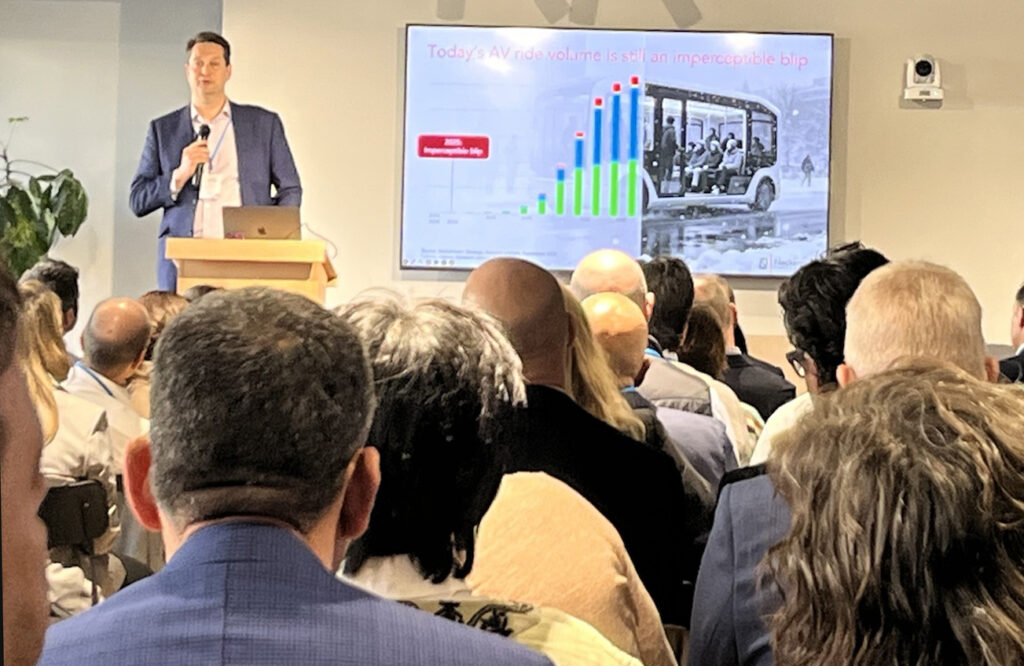
He then joined the first panel of the day, on a European value chain, alongside Charlotte Eisner of Bolt, Nicolas Morael of Transdev, Kai Liu of Pony AI, and Dominique Nivaggioni of Stellantis.
Bolt, which already operates extensive e-bike, e-scooter and ride-hailing schemes, is aiming to have 100,000 shared AVs by 2035.
Much of the debate centred on the upfront cost of vehicles and who owns what data. “Europe has a very mature mobility ecosystem,” noted Liu. “Standardisation helps to bring down costs for everyone.”
Morael, of French-based public transport operator, Transdev, asserted that “Mass transit will not be replaced by robotaxis”.
That was a thread running though multiple panels, with Neckermann highlighting ‘transport deserts and lack of choice’ even on the outskirts of London, let alone rural areas.
Next up was a panel on managing scaling – ‘deployment learnings in fleet’ – led by Laura Herzig of Beta Mobility and featuring Hans Fridberg of Holo Norway, Rainer Becker of MOIA, and Yong Gessner of Baidu.
Again, talk quickly turned to manufacturing costs and data processing. “We do not yet know the cost of growing a quality mass service,” said Gessner. “Also, Europe has the highest standards for data, so we need to meet that.”
Becker detailed how MOIA already has cars operating with safety drivers in Hamburg and is looking to expand to Oslo. It was noted that no two cities are the same, with each requiring a ‘hyper local’ approach.
Taking us into the first break, Anant Prakash, of Odysse, explained the benefits of their ride-hailing efficiency solution. With an average vehicle moving speed in London of 9mph (!) Odysse’s AI-powered tools are designed to increase ‘time on-trip’ and ‘fleet orchestration’.
Tensor or tea?
When we say break, many of us passed up the option of caffeine in favour of further info on ‘the world’s first personal robocar’. We’ve written about Tensor before but this was the first time we’d seen one, and Chief Business Officer, Hugo Fozzati, was over from San Francisco to give us the lowdown.
Sporting 5 lidar, 11 radar and 17 cameras, it claims to have the most powerful supercomputer ever put into a car. “It isn’t about horsepower any more, it’s about brain power,” said Fozzati. “You can drive it, or it can drive you. It can operate at Level 0, 2 or 4. It can be used as a robotaxi – we’re partnering with Lyft in Europe – or for personal use.”
Back in the main auditorium, Matthew Clark of Steer gave a brief overview of their research into emerging services. He then handed over to Bhavin Makwana to provide some eye-catching precdictions on the value of automated ridehailing in the UK – a combined gross output of £5.4bn across manufacturing and operations by 2050, with 18,300 jobs supported by 2035.
Next up was, by common agreement, the most thought-provoking presentation of the day, by UCL Professor, Arthur Kay. As you’d expect from the co-author of ‘Roadkill’, Kay provided a critical view of autonomous cars, highlighting multiple threats, from increased congestion and data concerns to national security risks.
“There are huge potential upsides if introduced correctly, but robotaxis are effectively fleets of 2-tonne corporate-controlled surface drones,” he said, advising that it is helpful to think of ‘big tech’ as akin to nation states. Both Nvidia and Alphabet boast market cap values higher than UK GDP.
As to what ‘correct intoduction’ looks like, the final panel before lunch focussed on regulation for cities. Led by Patrick Ayad of Hogan Lovells, it featured Richard Dilks of CoMoUK, Sam Pooke of FreeNow, Michael Talbot, of the Department for Business and Trade, and Daniel Quirke of Wayve.
“There are a lot of regulations, both nationally and internationally, which address the concerns we’ve just heard about, and how to deploy in a useful way,” said Quirke.
Ayad lauded the UK for leading on AV policy, with Talbot suggesting that government backing for the likes of Aurrigo, Oxa, Fusion and Wayve helped to attract Baidu, Waymo and others.
Pooke emphasised that there must be ‘some room to fail’, given the incidents involving human drivers. In the UK, that would require alignment between the DVLA and the relevant local authority with regards to Automated Passenger Service (APS) permitting schemes.
Then, it was luchtime, and a welcome opportinuty to chat with colleagues old and new. The latter included Hans Olms, Julia Schellnast, Chris Lichtmannecker, Wanqiu Hu and Julie Evensen – the target of meeting 10 new people easily surpassed already.
AV afternoon
Diffcult choices followed as panel sessions continued in both the main room and smaller View Room, so-called thanks to its glorious view of Big Ben.
The decision to go intimate paid dividends immediately with a fascinating debate on AV insurance moderated by Oliver Wilson, of Hogan Lovells, and featuring Andrea Kollmorgen of Simulytic, Gerry Ross of Allianz, Chris Moore of Apollo ibott, and the ABI’s Fraser Lyall.
There was broad agreement that self-driving will significantly disrupt long-established motor insurance verticals, but disagreement over the timescale.
Ross praised Level2 systems for reducing the frequency of incidents, but described L3 as ‘messy’. Kollmorgen agreed, adding that the shift to L4 could take-off quite quickly thanks to giants like Amazon and Uber.
Further cases like last year’s US$200m judgement against Tesla might speed-up the transition by pushing up the cost of traditional insurance, it was suggested, especially if the big AV operators can clearly demonstrate better safety than human drivers.
As to who the new insurers might be, Moore asserted that: “Google already have their own insurance company on Lloyds, but they are looking for partners – they don’t want to do it themselves.” An opportunity for smaller, more agile risk specialists to steal a march on their larger rivals?
Our final session in the View Room – apologies to those we missed! – was on investment in autonomous – equity, public, and private.
Moderated by Martyn Briggs of Bank of America, it featured Mark Cracknell of Zenzic, Loan My Descourvieres of Valeo, and Matthias Kempf of Leap4.
Briggs described it as “The ChatGPT moment for autonomy”, with “more funding than we’ve ever seen and consolidation into a few key players” – around US$20bn already in 2026.
“When tech meets deployment and business, there’s no turning back,” said Descourvieres. Kempf urged public and private collaboration “in everyone’s interests”.
Compelling use cases included: 1) taking grandma to look after the kids, and 2) hassle-free sharing of expensive farming equipment.
We then hotfooted it back to the main room for a panel on autonomous logistics and goods transport, hosted by Nick Reed, of Reed Mobility, and featuring Lara Amini of Loxo, Miles Garner of Aurrigo, Lisa Johnson of Starship, and Zeljko Jeftic of Einride.
In a wide-ranging discussion they covered everything from technical progress – ever less manual interventions – to the number of remote supervisors required – one per 10-20 vehicles? – and the need for UK AV and AI regulation to keep pace – Johnson highlighting how legislation passed in 1835 still impacts their work today!
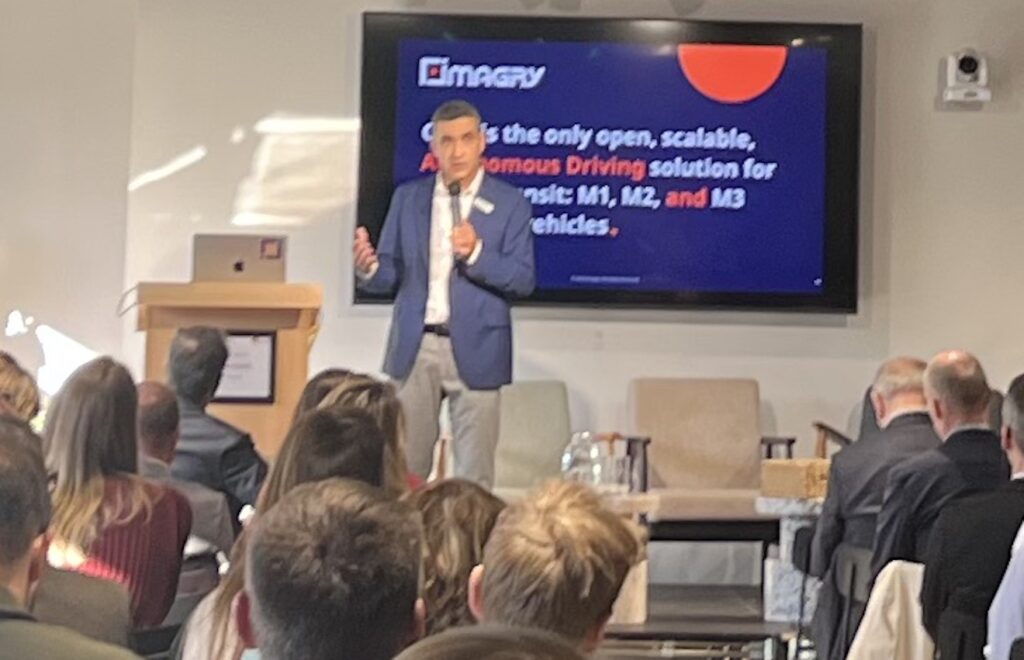
Sessions in the View Room had ended now, so the hall was packed as Eran Ofir of Imagry set out why their mapless driving system “is the only open, scalable autonomous driving solution for public transport M1, M2 and M3 vehicles” – everything from cars and minibuses to large coaches.
In the next panel, Autonomy’s Ross Douglas explored the vital subject of AV infrastructure with Daan Nap of Rocsys, Amir Nayeri of Neo, and Peter Cohen of Terawatt.
“If you only have five vehicles it seems a big step to spend millions on infrastructure, but if you don’t it will massively slow down your ability to scale,” warned Cohen.
It will involve buying or renting depots wherever needed, whether that’s a remote location or in the heart of the world’s most expensive cities.
From there, a lot of technologies and skills come together – battery storage and charging, cleaning, servicing and maintenance. “Powered land is one of the most underappreciated land categories,” said Nayeri.
Public trust
Neckermann then returned to talk transparency and public acceptance with Adam Bahlke of Motor AI, Sarah Barnes of AFTR Consulting, and independent road safety campaigner (and Self-Driving Consumer Champion) Meera Naran MBE.
“Without public acceptance, we have no business,” said Neckermann. “So what can we do to create trust?” Naran suggested that having a layperson on the board of every tech company would help, “To bust jargon and act as a critical friend.”
Fittingly, the final panel of the day, ‘The European Path to Autonomous’, was led by Guido Di Pasquale of PAVE Europe, and featured Saffiya Haddad of Benteler, and Martin Neubauer of PostAuto.
It focused on public transport, particularly first and last mile links to other hubs. “Some leading cities can be the lighthouses for the rest of Europe,” said Haddad.
The official proceedings closed with an inspirational keynote by Pierfrancesco Maran MEP, Chair of European Parliament’s Environment Committee.
“Europe is full of pilots but we need to accelerate,” he said. “We have to demonstrate we are one Europe, with one way to test, one way to collect data. There is currently not enough awareness among the European public about this transport revolution.”
What a day! Tickets for the AV Summit 2027 are already on sale and we can’t wait.