
Editor’s comment: “In this guest column, road freight industry specialist and commentator Andy Salter, MD of Salter Advisory, explores how autonomous trucks could transform not just vehicles, but the structure and economics of moving goods. Canvassing the views of leading autonomous HGV players at the recent IAA Transportation event in Hannover, he delves into all the big subjects, from tech progress and initial hub-to-hub services, through licensing and liability shifts, to wider workflow and supply chain changes. Get yourself a cup of tea because this is a long one, but it’s well worth it I promise.”
Beyond the autonomous truck: building the system for Level 4 freight
The next stage in autonomous freight development may be less about teaching trucks to drive and more about building the technical, operational and regulatory systems that allow them to drive without somebody sitting behind the wheel.
Look further ahead and an even more interesting question emerges: what happens to the way we move goods when the driver is no longer the organising principle around which much of road freight has been built?
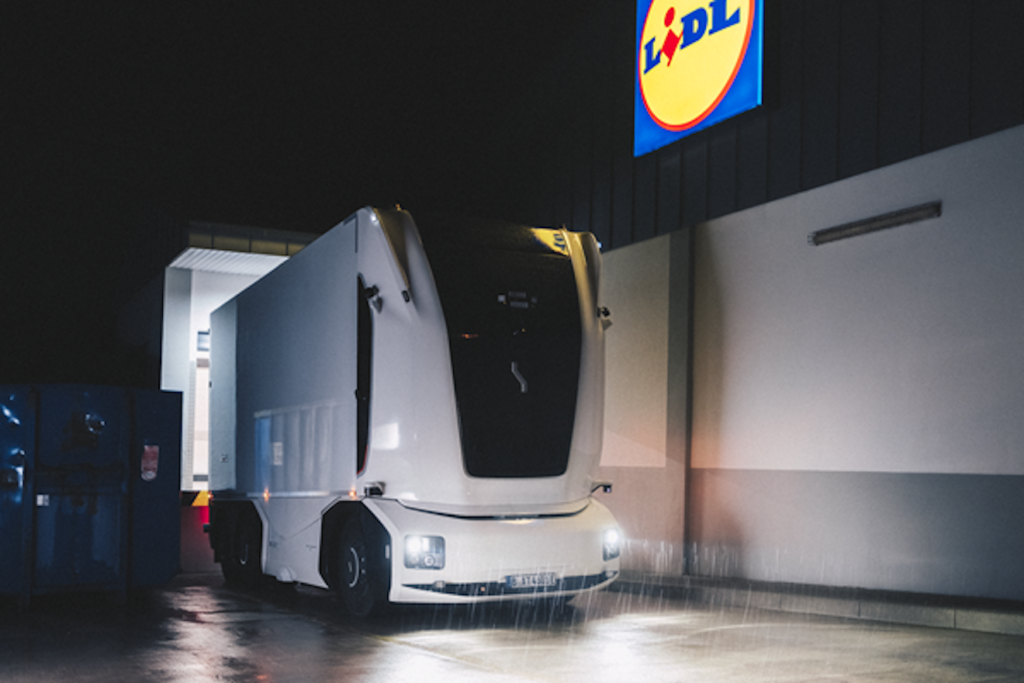
That distinction was becoming increasingly apparent at IAA Transportation in Hanover. Lidl and Einride announced a Level 4 cab-less battery-electric freight operation on German public roads, while MAN outlined the lessons from its Atlas-L4 programme and Chinese autonomous logistics specialist Neolix set out plans to bring technology already operating at significant scale into Europe.
Taken together, they suggest autonomous freight is beginning to move beyond the vehicle demonstration phase. They also expose how much infrastructure has to sit behind an apparently simple proposition: removing the driver.
MAN R&D chief Dr Frederik Zohm describes an autonomous transport system in three layers: the physical “robo vehicle”, the software platform responsible for decision-making and a control tower providing oversight of the wider operation.
The engineering of the first of those layers is increasingly mature. Modern trucks already offer lateral and longitudinal control through advanced driver assistance systems, while MAN’s Atlas-L4 programme has developed the redundancy required to move beyond driver assistance towards Level 4 operation, he explains.
That includes redundant steering and braking, and a redundant electrical architecture intended to allow the vehicle to achieve a safe state following individual system failures.
The project culminated in an autonomous truck operating for around 30km on a German motorway, but Zohm argues that demonstrating the driving task is only part of the challenge.
“For me, to really run 40 tonnes at 80km/h in a super-safe and secure way, and also be sure no one can control that vehicle, is a much wider issue bringing in many different aspects,” he says.

The difficult questions increasingly concern the edge cases and everything surrounding the dynamic driving task. Zohm uses the example of a truck breaking down. A human driver must secure the vehicle and, in Germany, place a warning marker behind it. An automated driving system may be capable of bringing the truck to a minimum-risk condition, but the physical intervention still has to be performed by somebody.
The same principle extends across freight operations. Coupling trailers, daily safety inspections, loading interfaces, security and exceptional events all have to be considered when designing an autonomous system. Removing the person from the cab therefore requires much more than automating steering and braking.
Defined domains rather than universal autonomy
That helps explain why Zohm expects autonomy to develop through tightly defined applications rather than appearing simultaneously across road freight. MAN sees yard manoeuvring as one of the most attractive initial use cases.
It combines a controlled environment with a measurable economic benefit and allows sensor technology already required on the truck to automate repetitive movements without necessarily requiring extensive external infrastructure.
From there, the operational design domain can expand as capability, economics and regulation permit. The Lidl-Einride deployment provides a useful example. Rather than attempting unrestricted autonomous freight, the operation connects Lidl’s Edermünde distribution centre with a nearby store using an SAE Level 4 cabless battery-electric vehicle.
The significance is not simply that the vehicle has no cab, but that a defined autonomous freight operation has received approval from Germany’s Federal Motor Transport Authority.
This route-based approach potentially makes freight particularly suitable for Level 4 deployment. A vehicle does not need to solve every conceivable driving environment if its authorised operating domain can be restricted to a particular route, geography, speed range or operating condition. The result is less a universal autonomous truck than an autonomous transport system designed around a specific task.
The virtual driver
Chinese autonomous vehicle specialist Neolix provides another perspective because it is already operating autonomous vehicles at scale. The company says it has deployed around 27,000 RoboVans worldwide, predominantly in China, with more than 230 million autonomous kilometres accumulated.
Its vehicles are below 3.5 tonnes and focused on urban middle and last-mile logistics rather than heavy trucks, but the operational architecture is instructive.
“You are not selling a vehicle,” says Neolix Europe head Dr Yong Gessner [who we heard speak at the 2026 Euro AV Summit]. “You are selling a virtual driver. This driver is artificial intelligence.”
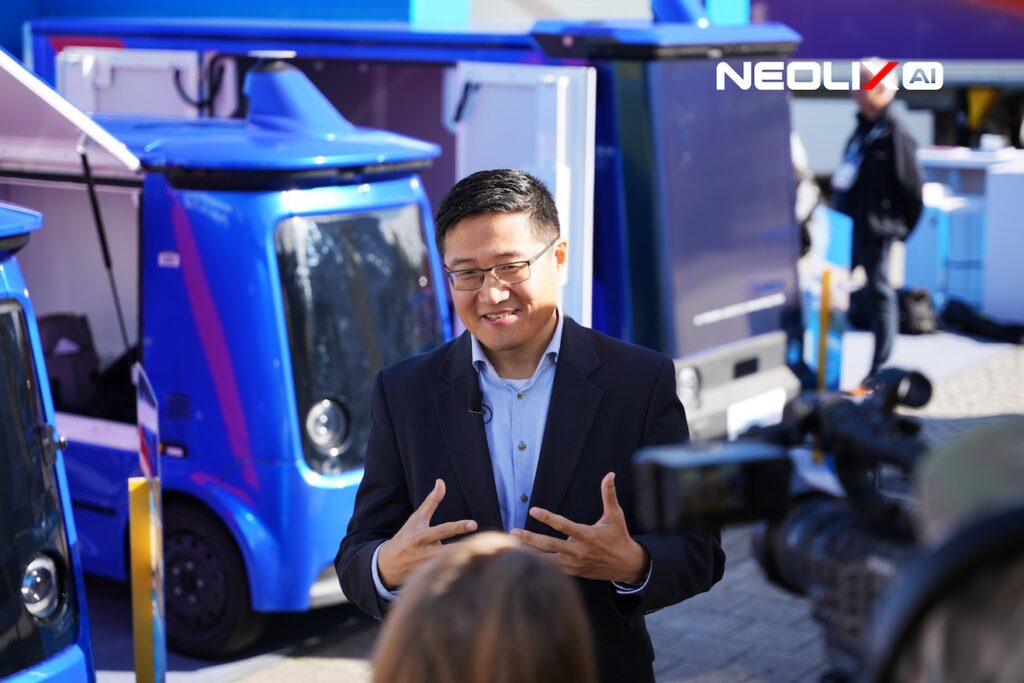
That changes the relationship between the technology provider and the vehicle throughout its lifecycle. A conventional commercial vehicle OEM can sell a vehicle and transfer much of the operational responsibility to the customer. An automated driving system has to remain capable of performing the driving task throughout operation, supported by software, data and ongoing validation.
Neolix therefore uses multiple layers of redundancy. Gessner describes redundancy in perception through lidar and other sensors, computing redundancy and connectivity redundancy, supported off-board by remote supervision. But he draws an important distinction between supervision and remote driving. “Once you control the vehicle, the liability shifts to the remote controller,” he says.
The aim is consequently not to create a human driver sitting somewhere ready to take over. The autonomous driving system remains responsible for the driving task, including minimum-risk manoeuvres, while the remote supervisor provides higher-level assistance when the vehicle encounters exceptional situations.
This distinction becomes increasingly important as autonomous fleets scale. Early deployments may require relatively intensive human oversight, but the economic case improves as a single control centre can supervise increasing numbers of vehicles. Autonomy therefore does not necessarily remove humans from the system. It changes where they sit and what they do.
Regulating the system
The UK’s developing regulatory framework illustrates the same shift from regulating drivers and vehicles towards regulating a distributed autonomous system.
Under the Automated Vehicles Act (AV Act) 2024, an authorised self-driving vehicle must have an authorised self-driving entity responsible for the way the vehicle drives. For vehicles capable of completing journeys without a user in charge, the legislation also provides for a licensed no-user-in-charge (NUIC) operator responsible for operational oversight.
That creates an important separation of responsibilities. The entity responsible for the automated driving system does not necessarily have to be the same organisation responsible for the wider operation. For autonomous freight, on which the Act makes virtually no reference, the implications are significant.
A logistics company could own or operate the physical truck while another company provides the autonomous driving system and another part of the operation provides remote supervision.
Government is still defining the detail, with its regulatory work covering vehicle authorisation, NUiC operator licensing, insurance, cyber security, data, in-use regulation and incident investigation.
The unanswered question for freight is how that new framework will interact with the established goods vehicle operator licensing regime, and where responsibility will ultimately sit when an autonomous truck, its virtual driver and the company moving the load are potentially three separate entities.
That framework illustrates why autonomy is increasingly a systems engineering challenge rather than simply a vehicle engineering problem. Gessner argues that regulators consequently need to be involved throughout development rather than appearing only at the point of approval. “We don’t see the regulator as our counterpart to give us approval,” he says.
“I see the authority as an equal partner.” MAN’s Atlas-L4 programme followed a similar model, with the manufacturer working alongside Autobahn GmbH, the KBA and TÜV while developing the vehicle and its operating framework.
Designing out the driver
Once a system is genuinely capable of operating without a user in charge, another question follows: why design the vehicle around one?
Einride’s Lidl vehicle demonstrates the most obvious manifestation of that thinking. With no driver aboard, there is no conventional cab. Neolix follows the same principle in smaller urban freight vehicles, allowing more of the vehicle’s footprint to be dedicated to its transport task. The technical consequences extend beyond packaging.
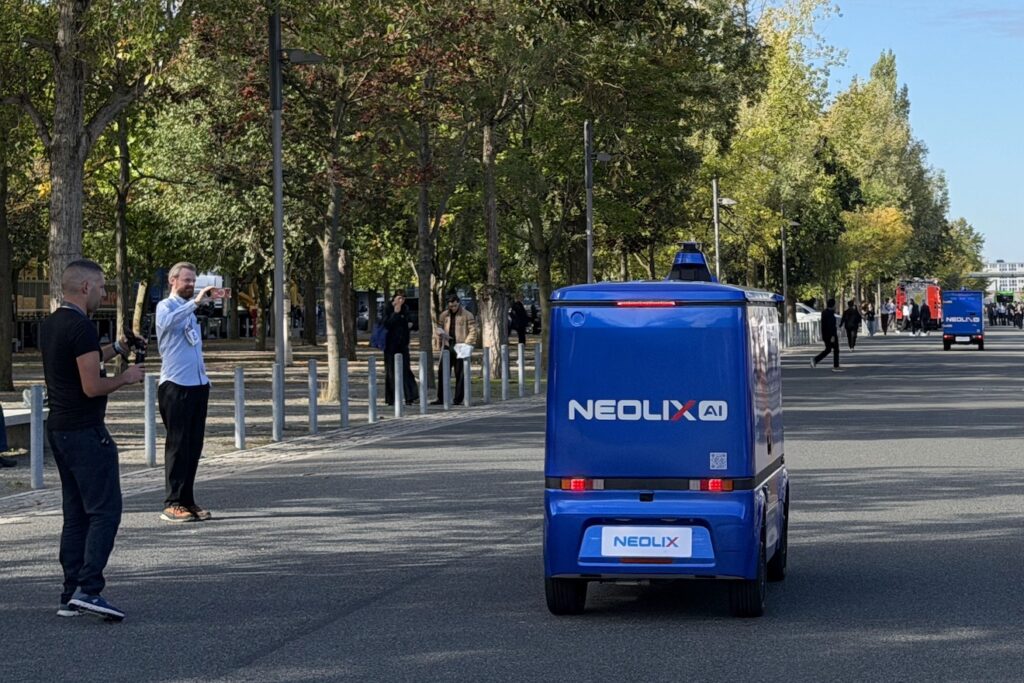
Purpose-built autonomous vehicles can potentially optimise sensor positioning, redundant systems, energy consumption and maintenance access around an automated duty cycle rather than accommodating both human and automated operation.
Traditional truck manufacturers face a different challenge because their vehicles serve a far wider range of applications and, for the foreseeable future, most will still require drivers.
The industry could therefore ultimately develop parallel architectures: conventional trucks with increasingly sophisticated automated capabilities and purpose-built driverless vehicles for tightly defined operating domains.
What if autonomy changes freight, not just the truck?
For a CAV industry understandably focused on whether technology can safely replicate the human driving task, freight poses a rather different question: what happens to the transport system once it can?
Much of today’s road freight operation has evolved around the driver. Drivers’ hours regulations influence when vehicles move and stop, shift patterns influence depot operations, and the availability and cost of drivers affects vehicle utilisation. Even the basic architecture of the truck is built around providing a safe and increasingly sophisticated working and living environment for the person controlling it.
Remove that constraint and the potential change is considerably more profound than replacing the person behind the wheel with software. It does not necessarily lead to 44-tonne autonomous trucks roaming unrestricted around Britain’s road network.
A more plausible development could be networks of defined autonomous freight corridors connecting ports, distribution centres, manufacturing plants, consolidation hubs and major retail locations. Autonomous vehicles might undertake the predictable trunk or middle-mile element of the journey, transferring freight to conventional vehicles where human flexibility continues to offer an advantage.
The implications could reach well beyond the vehicle. If autonomous freight can operate for longer hours and increasingly outside conventional shift patterns, logistics businesses could reconsider when goods move and where they are transferred. Distribution centres, charging facilities and consolidation hubs might increasingly be designed around the needs of autonomous flows.
Freight which currently travels at particular times because that is how the human operation has evolved could be rescheduled around road capacity, energy availability and customer demand instead.
The Lidl-Einride operation is interesting precisely because it provides a small-scale illustration of this principle. The objective is not to build a vehicle capable of going everywhere, but to automate a repeatable freight flow between two points. Scale that concept across a national logistics network and autonomy starts to become a supply chain question rather than a vehicle question.
And who moves the goods?
This is where the implications become potentially uncomfortable for the existing freight industry. Today’s road transport market has been built around hauliers acquiring vehicles, employing drivers and selling transport capacity.
But if the autonomous driving system is supplied and continuously supported by a technology company, vehicles are overseen through a control centre and customers increasingly purchase guaranteed freight capacity rather than a particular truck and driver, the traditional boundaries between manufacturer, technology provider, operator and customer begin to blur.
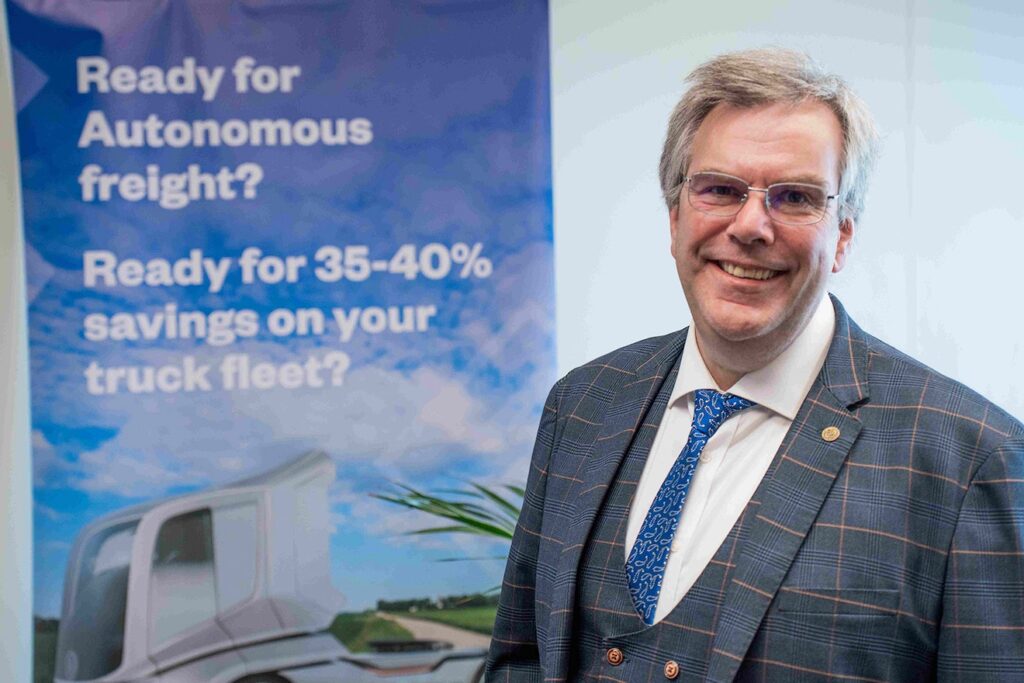
Autonomous freight advocate Michael Boxwell, founder of eHGV charging specialist Voltempo, argues that this could place the traditional carrier under pressure. His thesis is not that logistics expertise becomes redundant, but that competitive advantage could migrate away from owning trucks and employing drivers towards controlling customers, freight flows, data, infrastructure and the platform orchestrating the operation.
That opens the market to a different combination of players. OEMs could become systems integrators rather than simply manufacturers. Autonomous driving developers could become transport providers. Infrastructure and energy companies could assume a larger role in orchestrating fleets.
Major retailers and manufacturers with sufficiently predictable freight volumes could purchase autonomous capacity directly rather than necessarily contracting for trucks and drivers through the traditional model.
Existing logistics operators are equally capable of occupying those positions, and their knowledge of freight operations, customers and the innumerable exceptions involved in moving goods should not be underestimated. But doing so may eventually require them to think of themselves less as owners and operators of trucks and more as managers of transport networks.
The genuinely disruptive question for autonomous freight may therefore not be when the driver leaves the cab, but who captures the value once they do.
The next autonomous challenge
None of this suggests that unrestricted driverless HGV operation is imminent. Zohm remains cautious about the pace at which heavy-duty autonomy will develop, particularly in Europe, while Gessner, despite Neolix’s experience with smaller autonomous vehicles, is similarly cautious about assuming that model transfers quickly to 44-tonne trucks.
But the nature of the challenge is changing. Five or ten years ago the central question was whether a vehicle could perceive its surroundings and drive itself safely. That remains fundamental, but successful Level 4 freight deployment now requires a much broader answer.
The vehicle needs redundant systems capable of reaching a safe state, the automated driving system needs to operate reliably within a defined domain and remote supervision needs clear technical and liability boundaries. Operators need procedures for physical interventions and exceptional events, while regulators need evidence that both the technology and the organisations behind it remain safe throughout operation.
All of those elements also have to make economic sense as one system. Solve them and the consequences may extend considerably further than the autonomous truck itself.
The opportunity is to rethink how freight moves, when it moves, the infrastructure supporting it and ultimately which organisations provide that movement. The technology may remove the driver from the truck. The more profound possibility is that it also changes the road freight system that was built around them.