
The hydraulic arm of Unimate, installed on General Motors’ New Jersey production line in 1961, remains a quintessential symbol of modern vehicle manufacturing. Programmable, using a magnetic drum memory, it is now regarded as the first industrial robot.
Back then, machines that could walk and talk were the stuff of sci-fi. Not anymore. Let’s look at a few of the newer types, and the important roles they’re performing across automotive.
Collaborative Robots
A further hat tip is due to GM for pioneering collaborative robots in the mid-90s, coining the term ‘cobots’ in the process. As the name suggests, they were designed to work alongside people, making life easier and saving time for superior skilled humans.
At Ford’s plant in Cologne, cobots assisted in assembling shock absorbers, literally doing the heavy lifting in a job which previously resulted in a lot of shoulder injuries. Thanks to rocketing processing power, they soon graduated to more advanced jobs, like drilling and machining.
By 2019, Ford had teams of UR10 cobots working on everything from polishing delicate loudspeakers to sanding body shells. By working in a carefully choreographed sequence, six cobots could sand a Fiesta’s entire body surface in 35 seconds.
“The cobots can feel when more force needs to be applied, just like we can, and they can easily get to hard-to-reach places, like the centre of the roof,” said Dennis Kuhn, Senior Manufacturing Engineer for Paint Shop at Ford of Europe.
Allaying fears that they were replacing workers rather than helping them, in 2022, Ford partnered on the award-winning Robbie the Cobot project, with RWTH Aachen University.
“Robbie the Cobot has helped demonstrate the wide range of roles that disabled people and people with reduced mobility can fulfil if care is taken to design a workplace that specifically fits their needs,” said Oliver Färber, Plant Manager for Cologne Powertrain Operations. “Collaborative bots could help create more jobs, as well as extend the careers of our existing employees.”
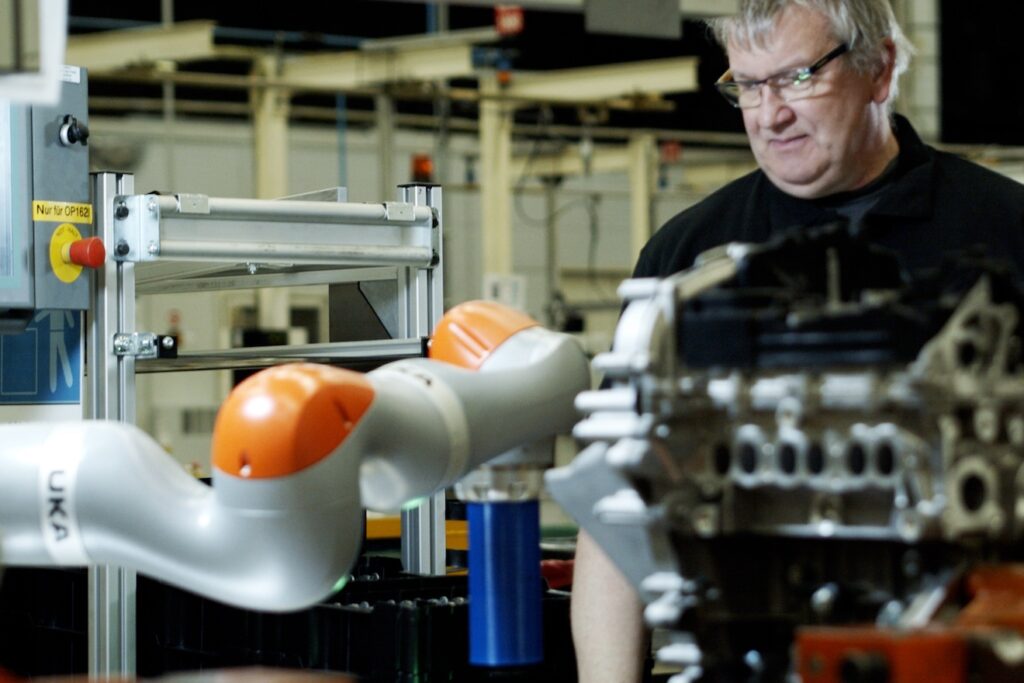
One project participant, production line worker Dietmar Brauner, feared his 30-year career was about to be cut short. “It got harder and harder for me to do my job, then along comes this little robot and it’s like having an extra arm – a very strong arm,” he said. “It’s changed everything. I hope it will open the door for others like me to get the chance to do, or keep doing, jobs they love.”
Autonomous Mobile Robots
Up to this point, most industrial robots had been static, firmly fixed to the floor or workbench. Simultaneous advances in automation hardware and artificial intelligence (AI) were about to change all that.
It seems incredible that ChatGPT, the chatbot which brought generative AI to the attention of the masses, was released scarcely three years ago. In robotics, the capabilities of Automated Guided Vehicles (AGVs) were already improving. Then, in 2012, Amazon paid US$775 million to acquire warehouse automation company Kiva Systems. It was a gamechanger.
Last year, Amazon Robotics deployed its millionth robot, mainly lifters and tugs. Importantly, the new generation are classed as Autonomous Mobile Robots (AMRs) rather than AGVs. They use sensors and AI to actively navigate, rather than simply following pre-set pathways.
In 2024, BMW unveiled a new, four-legged AMR at its Plant Hams Hall facility near Birmingham. Characterised as a robot dog and nicknamed SpOTTO, after BMW co-founder Gustav Otto, it is a cutting-edge robot equipped with visual, thermal and acoustic sensors.
Created by US-based Boston Dynamics, SpOTTO can climb stairs and perform complex sequences of movements. Its initial two tasks at Plant Hams Hall were: 1) scanning to enhance the facility’s digital twin, and 2) supporting maintenance, for example, by monitoring the running temperature of manufacturing equipment. Other potential uses include identifying leaks in compressed air lines and reading analogue operating controls
“Virtualisation, automation and AI are central pillars of the BMW iFactory,” explains Klaus von Moltke, SVP of Engine Production at BMW AG. “Bold, innovative applications like those at Plant Hams Hall showcase the full range of possibilities.”
According to a May 2025 report by Research and Markets, the global AMR market is estimated to double from US$4.49 billion today to US$9.26 billion by 2030.
Noting that “AMRs allow automotive manufacturers to speed up the flow of materials, shorten lead times, and achieve more efficient production”, the report highlighted the health and safety risks associated with human-operated forklifts, and the increasing popularity of robots-as-a-service (RaaS), linking the units to cloud-based systems.
Humanoid Robots
There’s one kind of ‘physical AI’ that captures the imagination more than any other: Humanoid robots.
In January, Tesla CEO Elon Musk announced plans to discontinue the Model S and Model X, with its California factory being repurposed for the third generation Optimus robot. Standing 173cm tall, it boasts22 degree-of-freedom (DoF) hands, offering near-human-level dexterity. Tesla is also strengthening its AI expertise with a US$2 billion investment in xAI, the subsidiary of SpaceX best known for the Grok AI assistant.
Fans of the BBC quiz show QI might recall an appearance by the Advanced Step in Innovative Mobility (ASIMO) robot back in 2011. Since then, Honda has made huge advances in DoF hands for its Avatar Robot, designed to act as “a second self of the user”. A prototype recently demonstrated incredible versatility by picking up a small delicate object, then opening a tightly closed jar.
Such challenges have long been popular in robotics. In the UK last year, Mosaic, from the Prorok Lab at the University of Cambridge, won the Smart City Robotics Competition in Milton Keynes, beating teams from Bristol, Cranfield, London, Northampton and Sheffield.
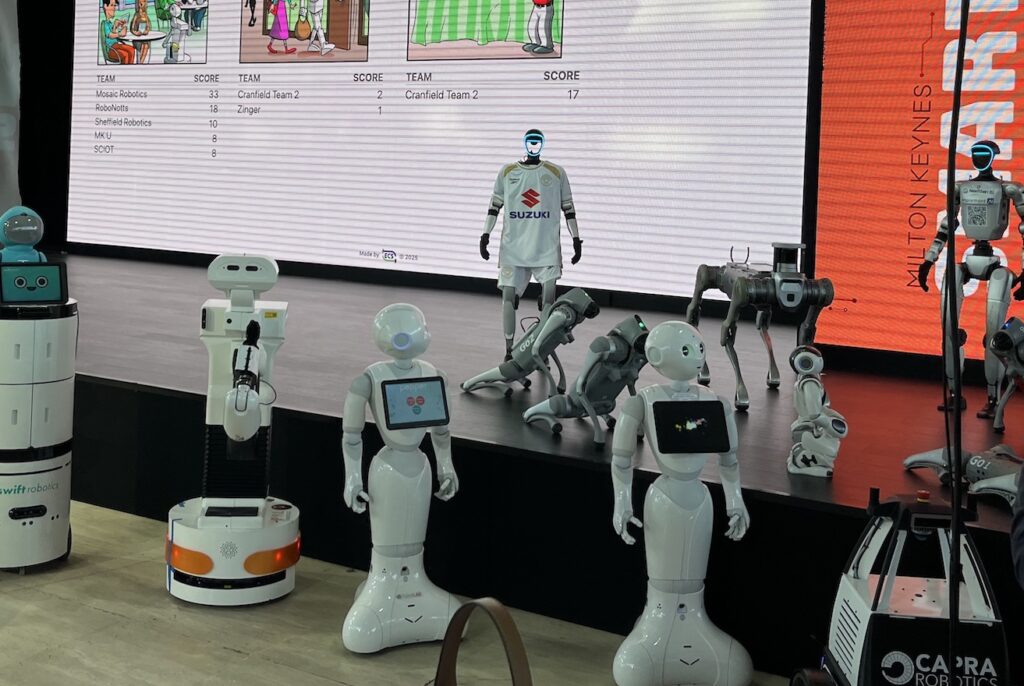
The ground-based tasks included: taking orders and delivering food and drink to a table; assisting a person with limited mobility to retrieve an object; and correctly picking items to fulfil a warehouse order.
The event was run by Smart City Consultancy, which is also a partner in the city’s self-driving shuttle project. “The robotics comp showcases how robots of all shapes and sizes are getting ever more adept at performing all manner of roles to support everyday human life,” said CEO Ian Pulford. “Simultaneous localisation and mapping (SLAM) is always a big part of it, as is in-depth knowledge of the Robot Operating System (ROS) software libraries and tools.”
From factory AMRs to meet-and-greet humanoids in dealerships, robots are set to play an increasing role in automotive. In fact, with some machines already blurring the line between robots and vehicles, you could equally say that automotive will play an increasing role in robotics.
Please note: a version of this article was first published in the March 2026 issue of the Institute of the Motor Industry’s MotorPro magazine.