
Editor’s comment: “The founder of StrategiaNow Consulting and President of the Mobile Satellite Users Association in America, Roger C. Lanctot has given voice to the worrying experiences of emergency first responders attending incidents involving autonomous vehicles.
“With a deep knowledge of transportation best practice, those in US self-driving would do well to heed his advice, but can the UK do any better? Here, he assesses our regulatory attempts to empower the blue light services when dealing with AVs.”

UK robotaxi regs prioritize first responders
Like Sir Francis Drake, Wayve CEO Alex Kendall is now launched on a voyage of discovery. Unlike Drake, Kendall is not out to circumnavigate the world, just Greater London (excluding the airports), for now.
Wayve’s AI Driver is the modern-day Golden Hind. Like Drake, Kendall may bring home riches beyond the wildest imaginings, with Waymo, Baidu and others champing at the bit to secure their share of the UK robotaxi market.
Homegrown AV maven Wayve has taken the first bite, securing approval from Transport for London (TfL) for a safety-driver-assisted deployment in partnership with Uber. According to media reports, regulatory approval for vehicles in fully autonomous operation without a safety driver, however, falls under the aegis of the Driver and Vehicle Standards Agency (DVSA), and is not expected in 2026.
There are several factors contributing to the significance of the TfL permit grant. It’s a first for London. It supports Wayve and its self-described mapless vision of autonomous operation vis-à-vis Waymo’s supposed map-based approach.
It follows the introduction earlier in 2026 of autonomous vehicle deployment guidance from the Centre for Connected and Autonomous Vehicles (CCAV) within the Department for Transport, including a Code of Practice (adopted in June 2026) specifically governing safety-driver enhanced trials.
DfT guidance on liability
The guidance offered up by the Department for Transport (DfT) clearly prioritizes first responder interactions with AVs including identification, communication, and the management of vehicle controls. What is notable about first responders potentially taking control of an AV is the identification and management of shifting insurance liability.
The guidance states: “The liability arising from the operation of a pilot vehicle depends on the circumstances of the incident.
“If the vehicle is not being controlled or overseen by a safety driver, or where the vehicle has received assistance that supports but does not itself amount to driving, liability may fall to the piloting organization. This will, however, need to be established on a case-by-case basis through investigation. Alternatively, or additionally, the vehicle’s insurer may bear civil liability for an accident caused by the vehicle.
“If a pilot vehicle is manually controlled by someone, for example a first responder, then the authorized person that takes manual control assumes liability for that vehicle’s movements until such time as control is handed to another.
“If handed to another authorized person, the original person authorized should verify the authorization of the person it’s been handed to. If handed back to the ADS, the original person authorized must follow the recognized hand back procedure and make effort to verify the handover procedure has been recognized.
“If for any reason a vehicle is being controlled or overseen by a safety driver, that person is expected to be liable for the actions of the vehicle as a driver under current legislation.”
Remote and/or alternative controls
The guidance is almost comical in the extent to which it attempts to envision and prepare for every possible scenario. In fact, the Code of Practice specifically provides for updates to the Code as more is learned about human-AV interactions.
What is missing, for the moment, is an acknowledgement of the role of remote vehicle control or even in-vehicle alternative manual controls that passengers might access. It’s enough to make your head spin.
It’s easy to understand why such detailed guidelines and codes and regulations are called for prior to an AV launch. Just imagine yourself as a firefighter or police officer arriving at the scene of a crash involving a self-driving vehicle.

There is no driver to explain what has occurred and no controls to operate the vehicle. Without advance preparation, first responders will be slowed in their response which could cost valuable time and threaten lives.
This puts an even higher than normal priority on communication of vehicle data to first responders regarding the status and functioning of the vehicle and the identification of passengers. The guidelines provide for that as well.
However, the guidelines do not include a reference to satellite connectivity. Given the critical nature of communications, it is clear that a modern emergency response system should encompass satellite connections.
Service provider promises
Regarding the service itself, Uber says that passengers requesting an UberX, Uber Electric, or Uber Comfort may be matched with a Wayve ride at no extra cost, with upfront fares shown in the app, according to Uber.
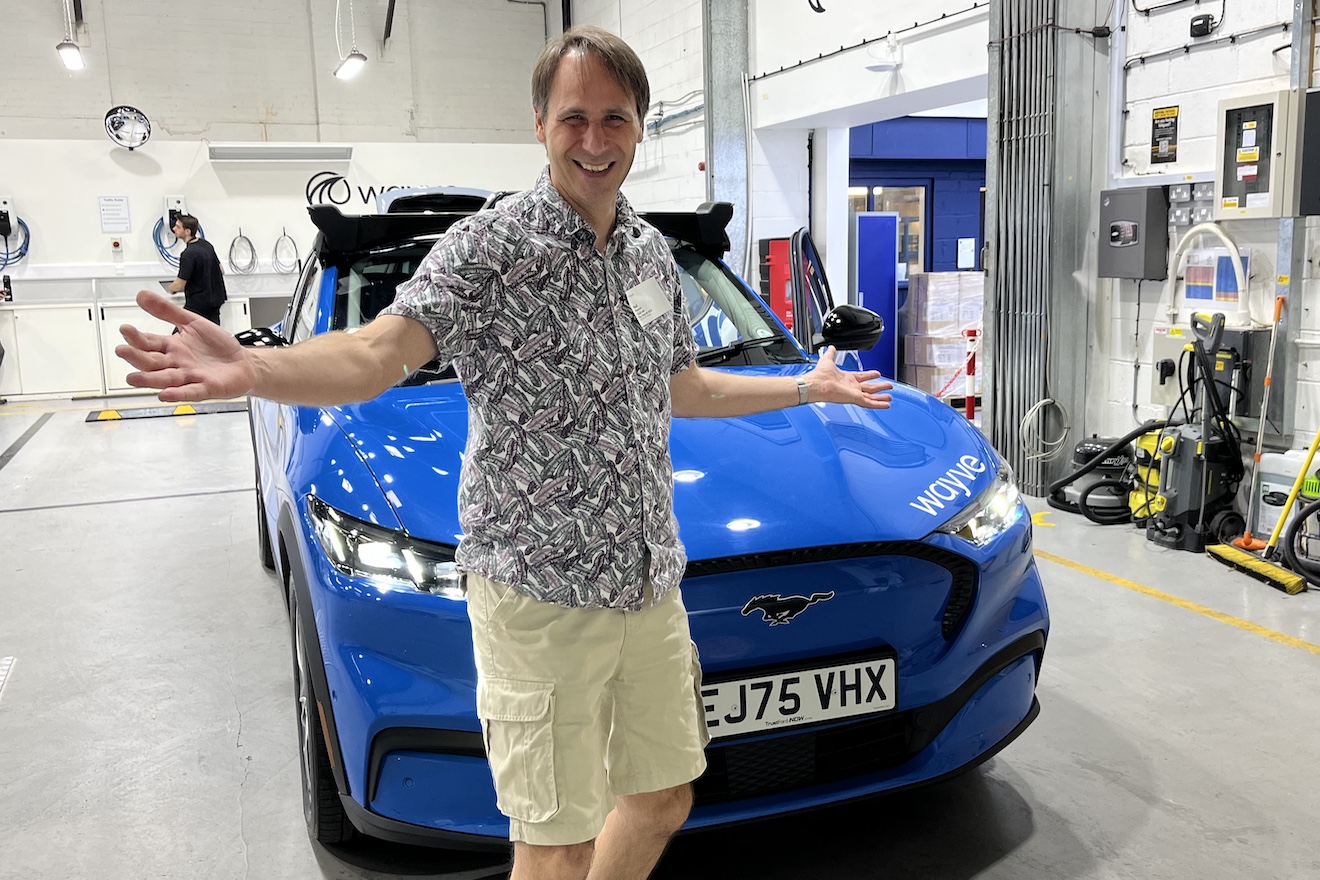
Uber says the 15 Ford Mustang Mach-E cars in the pilot will be equipped with the Wayve AI Driver. The in-vehicle experience will include interactive screens with interfaces available in 64 languages. As described by Uber, the process includes the following steps:
- On every trip, riders will have the option to accept or switch to a non-AV ride before the car arrives.
- Once the Wayve vehicle arrives, riders can unlock the doors and start the trip – from the Uber app.
- At launch, riders will be able to travel anywhere within London, apart from airports.
- The initial launch phase features supervised autonomous rides, meaning a trained and TfL licensed private hire driver is onboard to oversee the trip.
- The number of vehicles will grow over time in line with rider demand, readiness, and regulation.
- Customers who prefer a robotaxi can opt in via the trip preferences section of the Uber app.
Uber says more than 140,000 Londoners have already opted in to preferring a robotaxi. Wayve says it is preparing to scale with the new Nissan Leaf.
UK first responder focus
It is nearly impossible to identify every potential scenario that is likely to emerge with the operation of robotaxis in London. The guidelines and Code of Practice acknowledge this reality by providing for updates and modifications based on learnings.
In the US, robotaxis have violated crime scenes and construction zones, impeded and befuddled first responders, interfered with school buses, driven into deep “puddles”, clustered together inexplicably, lost connectivity, required assistance with unconscious passengers, and run over small animals.
The DfT has done its best to help Uber and Wayve and their ilk set sail on a safe course to autonomous nirvana. Only time will tell whether the guidance is equal to the task. The best that can be said for now is that first responders have been adequately provided for. Now we hope for the best.