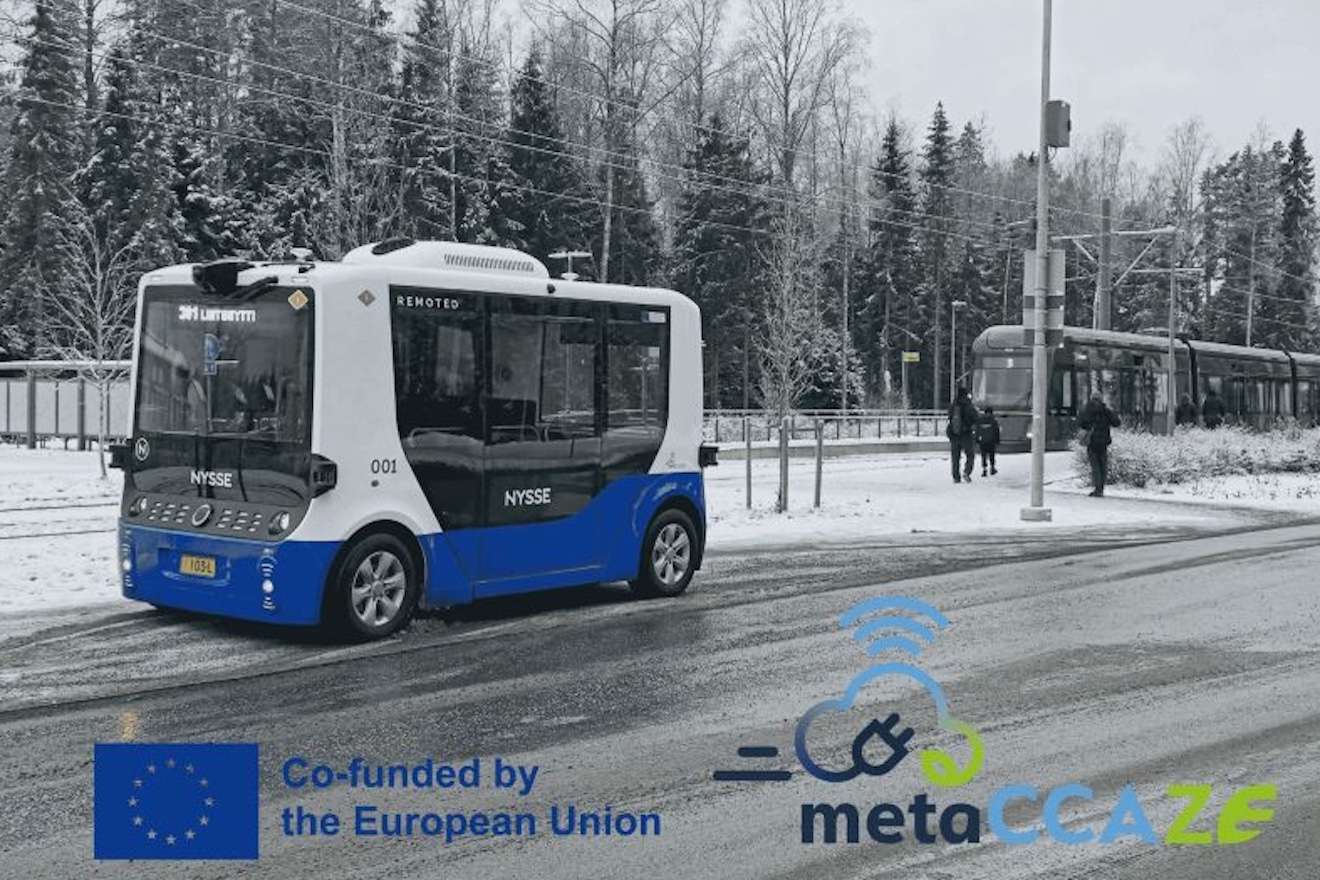

Editor’s comment: “In this new Cars Of The Future Guest Column, we invite leading experts in self-driving and related fields to give their personal opinions on key industry issues. First up, Marek Vanzura PhD, Chief Innovation Officer at autinno, winner of our 2025 Research Award, uses social media to gain important insights into the on-road performance of Chinese automated vehicles.”

Chinese robotaxi performance
Have you ever wondered how Chinese autonomous vehicles actually perform? With Baidu coming to London this year, to start a robotaxi service in cooperation with Uber and Lyft, this question is urgent. Considering the general lack of transparency, it is not an easy question to answer, but let’s try.
One of the best ways to assess AV performance is to evaluate recorded incidents on public roads. This helps to identify what is most challenging for these systems to handle, and thus what needs to be improved. It also helps to inform what improvements could be made on the infrastructure side, to make roads better for AVs.
Ideally, the collection of data on autonomous vehicle incidents would be centrally enforced by governmental entities, to whom operators would mandatorily report. Such data could then be made public, available to anyone who is interested. Reality is rarely ideal.
Globally, the most advanced system for reporting AV incidents is in California. The rest of the world is significantly lacking, so researchers must therefore turn to other sources. These typically involve media reports and evidence published online by random witnesses, usually on social media. In other words, open-source intelligence comes into play.
This approach does not provide the full picture, because many of the incidents go unreported. Also, perhaps the data is not very reliable. If companies operating autonomous vehicles don’t make their incident data available though, what other choice is there? In any case, it is important not to jump to conclusions based on such fragmented evidence.
For this article, let’s look at Baidu, the Chinese equivalent of Google. This technological giant has a branch dedicated to autonomous driving called Apollo, often portrayed as the Chinese answer to Waymo, as they both focus on robotaxi and have demonstrated driverless capabilities. However, while Waymo is primarily focused on deployments across the US, with exceptions including Tokyo and London, Baidu Apollo executes a very expansive strategy.
Besides China, where Apollo runs robotaxi services in cities such as Beijing, Wuhan, Chongqing, and Shenzhen, the company also targets overseas markets – the Middle East with Abu Dhabi and Dubai, and Europe. In Europe, the current focus is Switzerland, and the United Kingdom capital, London.
How do Baidu Apollo’s autonomous vehicles perform in their domestic market? We do not know for sure. The data that Baidu publicly shares is only related to successes. We can learn, for example, that their robotaxis provide over 250,000 rides a week. When it comes to incidents, data is scarce.
Social media evidence
To get a better understanding of the reality behind Baidu Apollo’s robotaxi, we have to look at the Chinese social media sites, such as Weibo, Bilibili, or Xiaohongshu, where Chinese netizens publish photos and videos of mishaps.
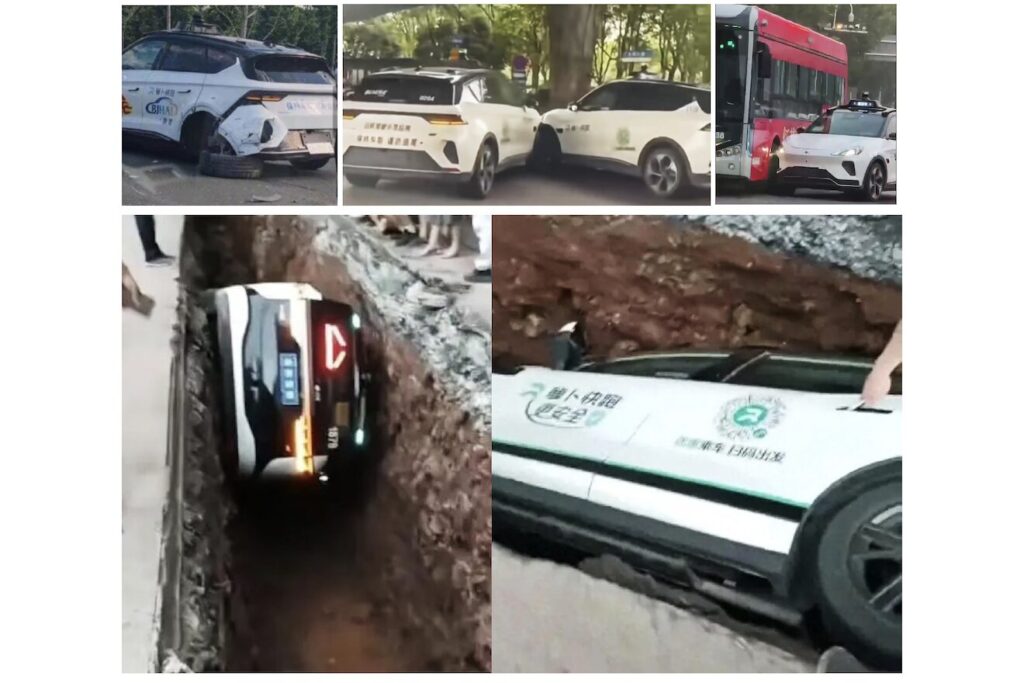
Social media can be a very rich source, not just regarding Baidu Apollo, but other Chinese operators, including WeRide and Pony Ai, and the companies behind autonomous delivery vehicles, such as Neolix or Zelostech.
Regarding Baidu, besides plentiful evidence of how autonomous vehicles can create traffic jams, there are also examples of more serious incidents, including crashes and collisions.
We know of several situations where a Baidu robotaxi was rear-ended, but due to a lack of data it is not possible to determine the cause – was it a distracted driver in the following vehicle, or phantom braking by the robotaxi itself?
There appears to be at least one example of a Baidu robotaxi colliding with a passenger car while changing lanes and not stopping. There is also evidence suggesting a collision between a Baidu robotaxi and a bus, and between two Baidu Apollo autonomous vehicles.
And what of the extremely worrisome photos and video documentation showing incidents involving vulnerable road users – pedestrians, cyclists, and other two-wheelers? More transparency would certainly be welcome.
Recently, evidence was widely shared showing a Baidu autonomous vehicle having apparently fallen into a construction pit.
Considering the Chinese autonomous vehicle companies, including Baidu Apollo, are coming to Europe, it is surely time to think seriously about these issues. What is being done to ensure they meet UK and European standards for safety and security?
As a minimum, our governments should demand access to incident reporting for every company that wants to deploy here, as well as setting up a reporting duty for any incidents on our own soil. Transparency should be the backbone of every autonomous vehicle deployment.
Disclaimer: Opinions expressed in this column are solely those of the individual contributors.