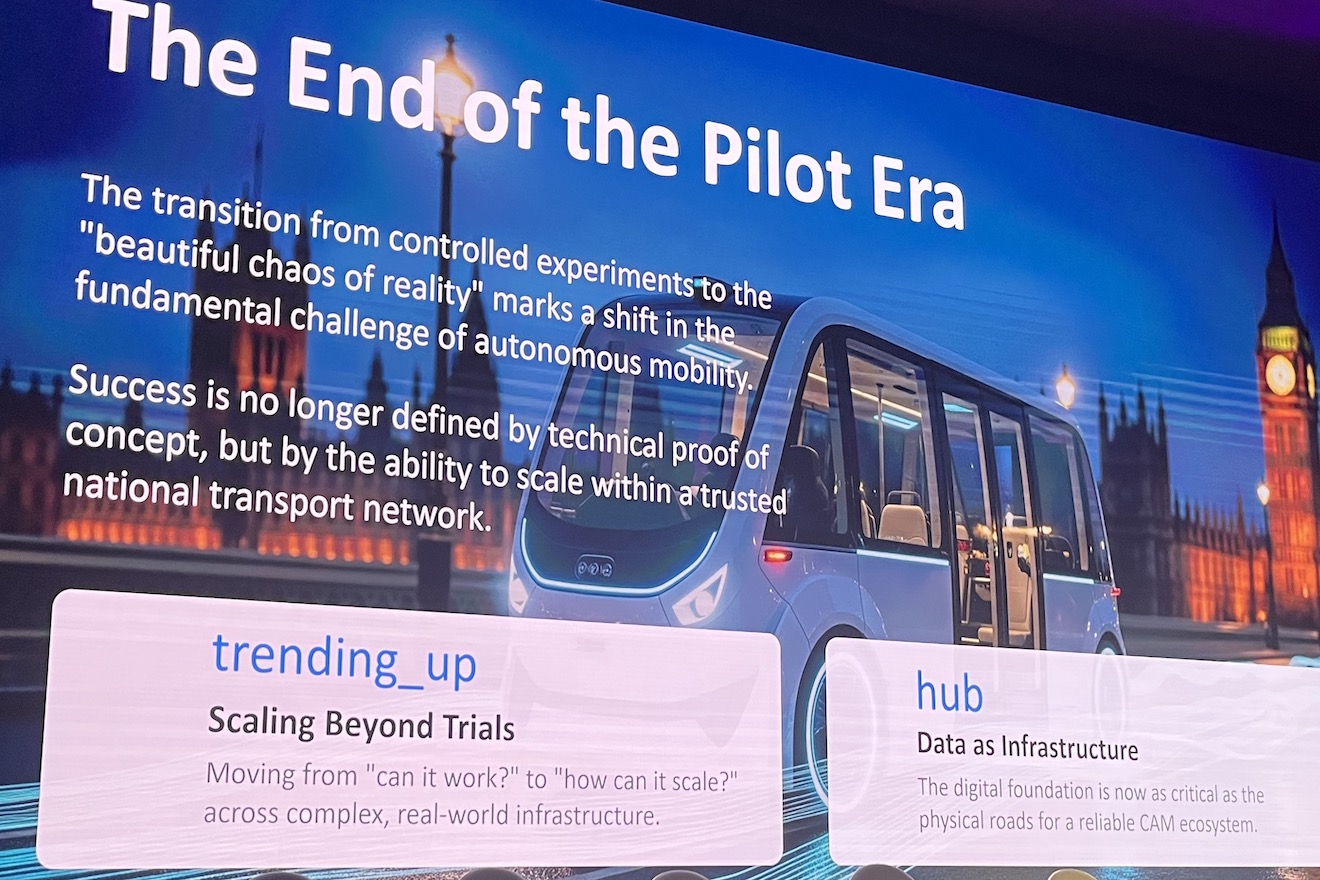
The luminaries of UK self-driving gathered at last week’s CAM Pathfinder Launch Event, hosted by Zenzic at the University of Warwick, eager to learn more about the four new government-backed funding competitions announced at Cenex: Mobilise, Demonstrate, Enable and Feasibility Studies.
After a rousing welcome by Zenzic’s Mark Cracknell – “The time for timelines is over. CAM is happening now, and Pathfinder is designed to make the UK its first commercial market” – Michael Talbot outlined some important organisational changes.
The Centre for Connected and Autonomous Vehicles (CCAV) has become part of the Automotive Unit at the Department for Business and Trade (DBT), where Talbot himself is now Head of CAM Industrial Policy.
New Self-Driving Ministers
Following September’s reshuffle, Ministers with responsibility for UK self-driving now include Peter Kyle MP, Secretary of State for Business and Trade, Chris McDonald MP, Minister for Industry in the Department for Energy Security and Net Zero (DESNZ) and the Department for Business and Trade (DBT), Sir Chris Bryant, Minister of State at the DBT, and Liz Lloyd CBE, Parliamentary Under-Secretary of State in the Department for Science, Innovation and Technology and the DBT.

“I quite like the analogy of Zenzic and the Advanced Propulsion Centre (APC) being the driving instructors, and Innovate UK being the examiner,” said Talbot, reiterating the high profile given to CAM in the recent Advanced Manufacturing Sector Plan, including the creation of 12,000 jobs in vehicle manufacturing.
4 New Funding Comps
He then handed over to Dave Matthews, Senior Project Delivery Lead at the APC, to talk Mobilise. “It’s as much about business development – beachhead strategy and scaling – as it is about technology development,” he said. The next funding round is scheduled to begin in December.
Dr Mihai Caleap, of Bristol-based Calyo, then spoke of the support his company has received in developing 3D ultrasound sensors for safer and more efficient advanced driver assistance systems (ADAS) and automated driving systems (ADS).
Alex Wood, of the APC, then covered how Demonstrate has been designed to “Support technologies to the point where you can put them in front of customers – from development and verification to manufacturing, scaling and export potential.” Available to single applicants or consortiums, this competition will open on 20 October.
Wood urged applicants to liaise with his team before submitting final proposals, noting that a third made themselves ineligible due to silly mistakes.
He then introduced Aaron Mandalia, Solution Manager for connected and autonomous vehicles at HORIBA MIRA, who explained how Project CERTUS has developed a new approach to ADS verification and validation (V&V), with the ability to insert virtual actors into physical testing.
Wood then outlined how the Enable competition will help companies capitalise on near to market opportunities, with Chris Appleby, of the North East Automotive Alliance (NEAA), giving insights into the 5G-CAL, V-CAL and P-CAL proof of concept projects.
Last, but not least, Wood detailed how the Feasibility Studies will support organisations at the near- or early commercial stage, helping them overcome barriers and unlock at-scale deployments. £100-250k is available for each selected 6-9 month study, and the competition is live, having opened on Friday 10th October.
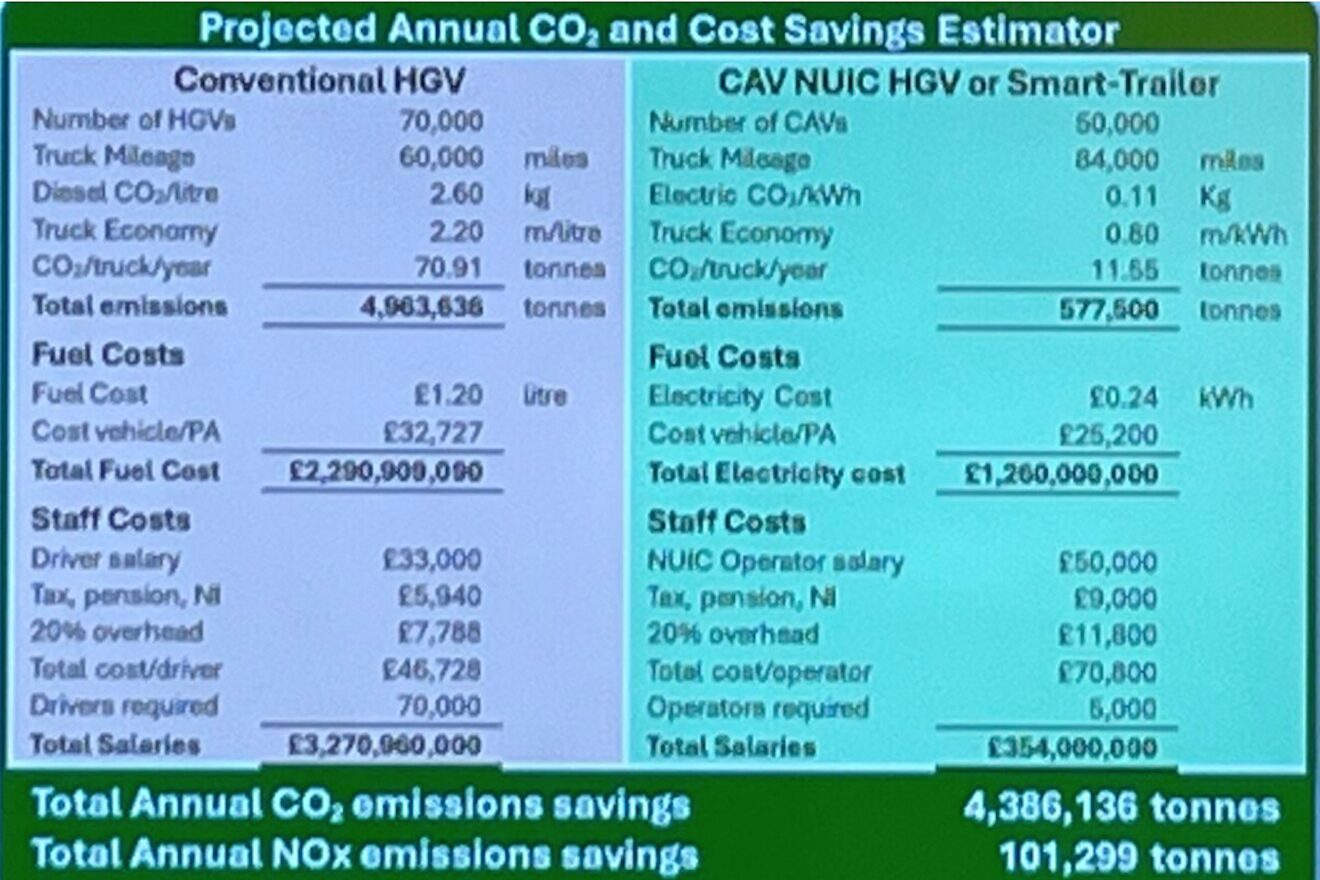
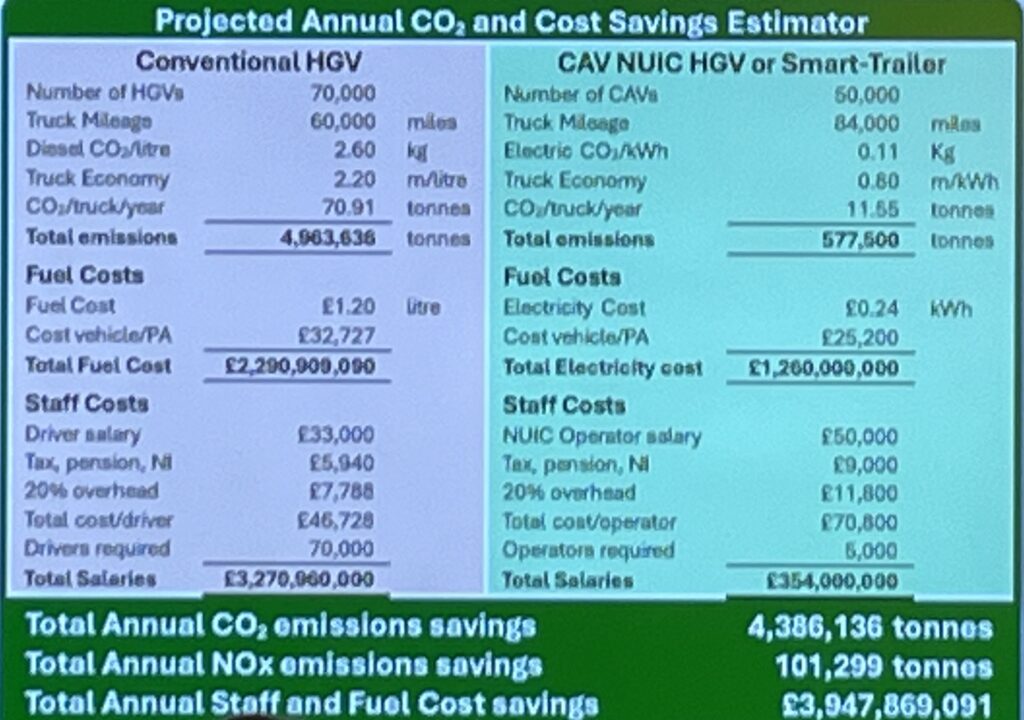
Michael Boxwell, Group CEO at HGV EV charging specialist Voltempo, then set out some pretty eye-catching multi-billion pound predicted emissions and cost savings from shifting to No User In Charge (NUIC) operations – see the slide below…
There was a lot to take in. Next, over to the APC’s Sunil Maher to explain how the four competitions can work independently or in combination. He urged delegates to explore all opportunities, including the Scale-up part of the Drive35 funding programme announced in July.
Q&As
There followed the first Q&A of the day, featuring Cracknell, Talbot and Innovate UK’s Bimba James.
“These grants will support world-leading research which will further strengthen the UK’s reputation as a global leader in CAM,” said Cracknell.
James highlighted the European Horizon projects as another potential source of CAM funding, and the fact that Innovation Loans have recently increased, from a maximum £2m up to £5m.
After a short break, Zenzic’s Francis McKinney provided an overview of UK supply chain priorities, highlighting “significant opportunities”. Starting with improved safety, other key CAM benefits include helping to address driver shortages and facilitating better infrastructure maintenance, all supporting wider economic growth.
Aurrigo COO Richard Fairchild then delved into the huge opportunity in airside operations, with the International Air Transport Association (IATA) estimating that the annual cost of ground damage alone could reach $10bn by 2035 – mostly avoidable via CAM.
Saving the best til last, Colin Maltby, Future Mobility Project Manager at Solihull Metropolitan Borough, did an exceptional job explaining the potentially rather dry subject of… the role of local authorities in enabling CAM deployment.
Starting with a clip from this Map Men video on the structure of English counties, he noted that responsibilities are about to change again due to the 2025 English Devolution and Community Empowerment Bill…
Maltby then launched into his top 20 ways in which UK local councils will be crucial to successful CAM, from taxi licensing and road planning to public transport provision and traffic management – more on that another day soon.
In the final Q&A session, the first three questions were all about UK regulations. Not so long ago the focus was much more on technology readiness. Progress indeed and next year will see further self-driving acceleration.
“The UK has a very international transport sector, and that’s a strength not a weakness,” concluded Talbot.