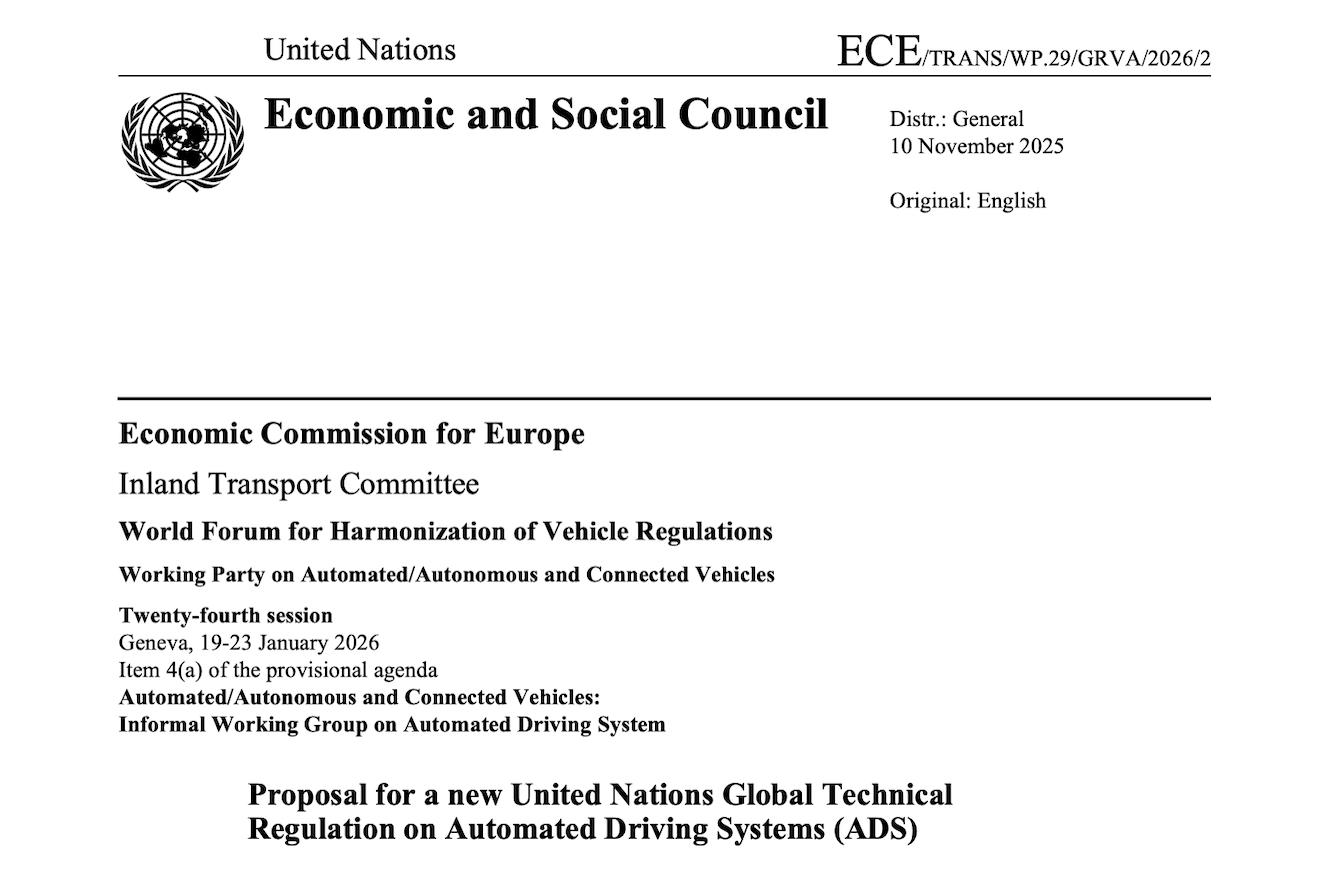
In early February, the United Nations Economic Commission for Europe (UNECE) published its long-awaited proposed global regulation to facilitate the safe introduction of self-driving vehicles on public roads.
The result of two years of intensive consultations and drafting, the new Global Technical Regulation (GTR) on Automated Driving Systems (ADS) was officially adopted by the UNECE Working Party on Automated and Connected Vehicles (GRVA) in January.
Designed to enable the deployment of autonomous vehicles with no supervision by an on-board driver, it establishes uniform safety provisions and a harmonized methodology for validating vehicles equipped with ADS.
Key points in the proposal include:
- Safety Management System (SMS): lifecycle safety governance including the audit and certification of the SMS.
- Testing credibility: requirements to demonstrate the credibility of test environments and methods, including in simulation.
- Safety Case: Manufacturers must demonstrate that the ADS is free from unreasonable risk.
- In-service monitoring & reporting (ISMR): including reporting to the relevant authorities to enable learning and corrective action.
- Data Storage System for Automated Driving (DSSAD): the capability to record and store safety-relevant ADS performance data.
Praise for proposed ADS regs
“The adoption of this draft regulation demonstrates the global relevance of UN-led regulatory platforms,” said UNECE Executive Secretary, Tatiana Molcean. “Harmonized vehicle rules developed at UNECE are essential to avoid fragmented national approaches and thus maximize economies of scale, and to support safety, market access and innovation in the automotive industry.”
Richard Damm, Chair of GRVA, added: “The adoption of this draft demonstrates that safety, innovation and public trust can advance together. By working globally, we provide clarity to the industry and confidence to consumers. GRVA will continue elaborating regulations on automated driving functionalities for Level 2, 3 and 4.”
Writing on LinkedIn as the Secretary of the working group, François E. Guichard, described it as a truly historic milestone. “This achievement marks the culmination of ten years of technical maturation and signals a decisive shift from research pilots to deployable, regulated automated mobility,” he said.
“I’ve had the privilege to witness the best of the United Nations in action – country representatives, experts from Non-Governmental Organizations (NGOs), Standards Development Organizations (SDOs) and all corners of the automated mobility ecosystem worked together to deliver a highly complex regulatory framework.”
Alex Kendall, CEO at London-based Wayve, praised it as a turning point. “Global deployment now has a clear, aligned regulatory foundation,” he said. “These frameworks define safety through system-level, evidence-based requirements, helping ensure the rules remain outcome-focused and technology-agnostic, so AV2.0 systems can be assessed fairly and deployed responsibly.”
From a US perspective, Zach Greenberger, CEO at Nexar, has written this great explainer on how the proposed global regulation fits with The Self Drive Act, not least how the National Highway Traffic Safety Administration (NHTSA) is being given “clear authority to regulate vehicles with automated driving systems”.
The UN proposal has been broadly welcomed by highways authorities in Europe, the UK, USA, Japan and China.
Persistent concerns
Not everyone is convinced though. Self-driving critic Michael DeKort said: “Here’s the problem. No regulatory or regulatory assistance/standard body I am aware of acknowledges the king is naked. In this case that is a development approach that is not viable from a safety, cost or time POV.
“The tell is in the data not provided. No one has seen ANY meaningful data by design from anyone. Data that ensures the engineering approach weaknesses of pattern recognition AI/ML and pixel level DL are mitigated. The most important data being how often the human “safety driver” intervenes and prevents crashes.”
The proposed regulation will go before the UNECE’s World Forum for Harmonization of Vehicle Regulations (WP.29) for adoption in June 2026.
The full proposal can be found online here