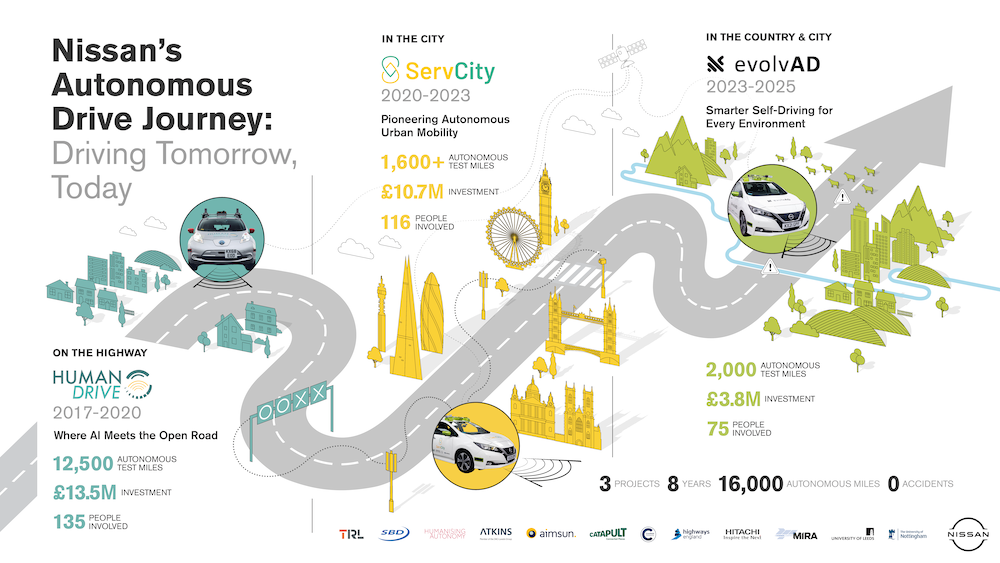
As one of the few global vehicle manufacturers committing seriously to self-driving, we’ve been covering Nissan’s impressive autonomous testing for years – from the HumanDrive and ServCity projects, to the 50mph rural road demos of evolvAD at Cranfield.
Shortly after that amazing experience, we sat down with evolvAD’s senior engineer, Nirav Shah, to get the lowdown on the cutting-edge technologies involved.
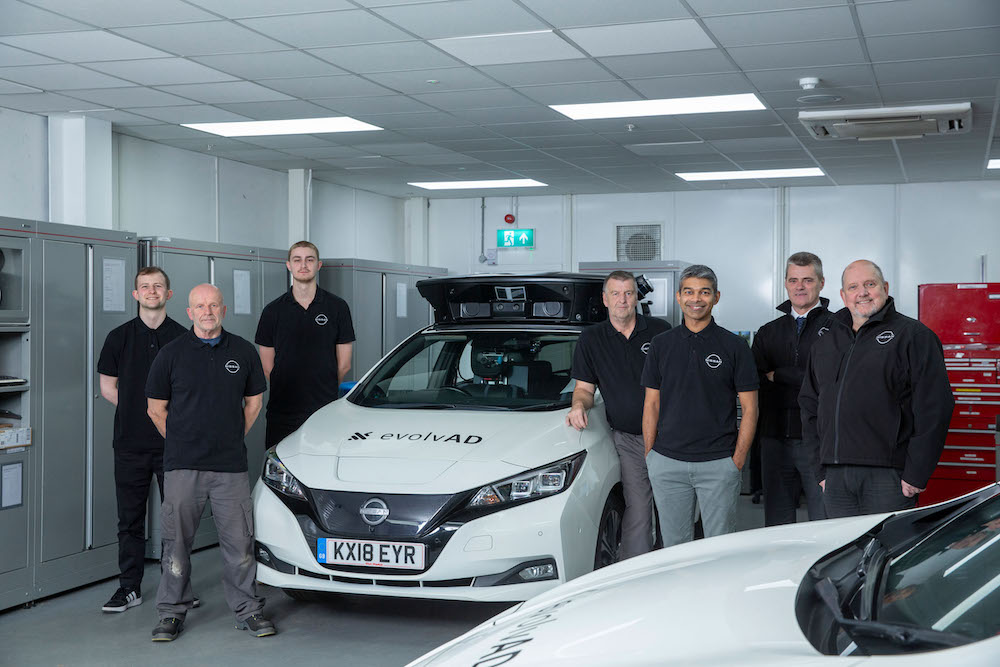
With a Masters degree in Automotive Systems Engineering from automation hotbed the University of Michigan, he’s worked full-time on Nissan’s Autonomous Drive Systems (ADS) for the last eight years.
“I was on both the previous UK projects, ServCity and HumanDrive, and I’m the main software developer for evolvAD,” he confirmed, modestly brushing aside the suggestion that makes him one of the world’s most knowledgeable self-driving technicians.
“Basically, it’s the same as humans. When driving from A to B, we need to know where we are at the start. In the autonomous driving (AD) world, we call that localisation. It could be GPS coordinates or Global Navigation Satellite System (GNSS) coordinates – latitude, longitude and altitude.
“Once we know our starting point, we like to know what’s around us. For that, the AD vehicle uses all the sensors – LiDAR to understand the speed and direction of other objects, then cameras to establish whether it’s a car, bus, truck, pedestrian, cyclist, dog etc. Together they give a 360-degree view of what’s around us.
“Then comes the path planning stage, followed by the decision-making layer – whether to go ahead or wait – and finally the control layer – actuators in the steer-by-wire and brake-by-wire systems to steer, accelerate or brake.”
Self-driving sensors
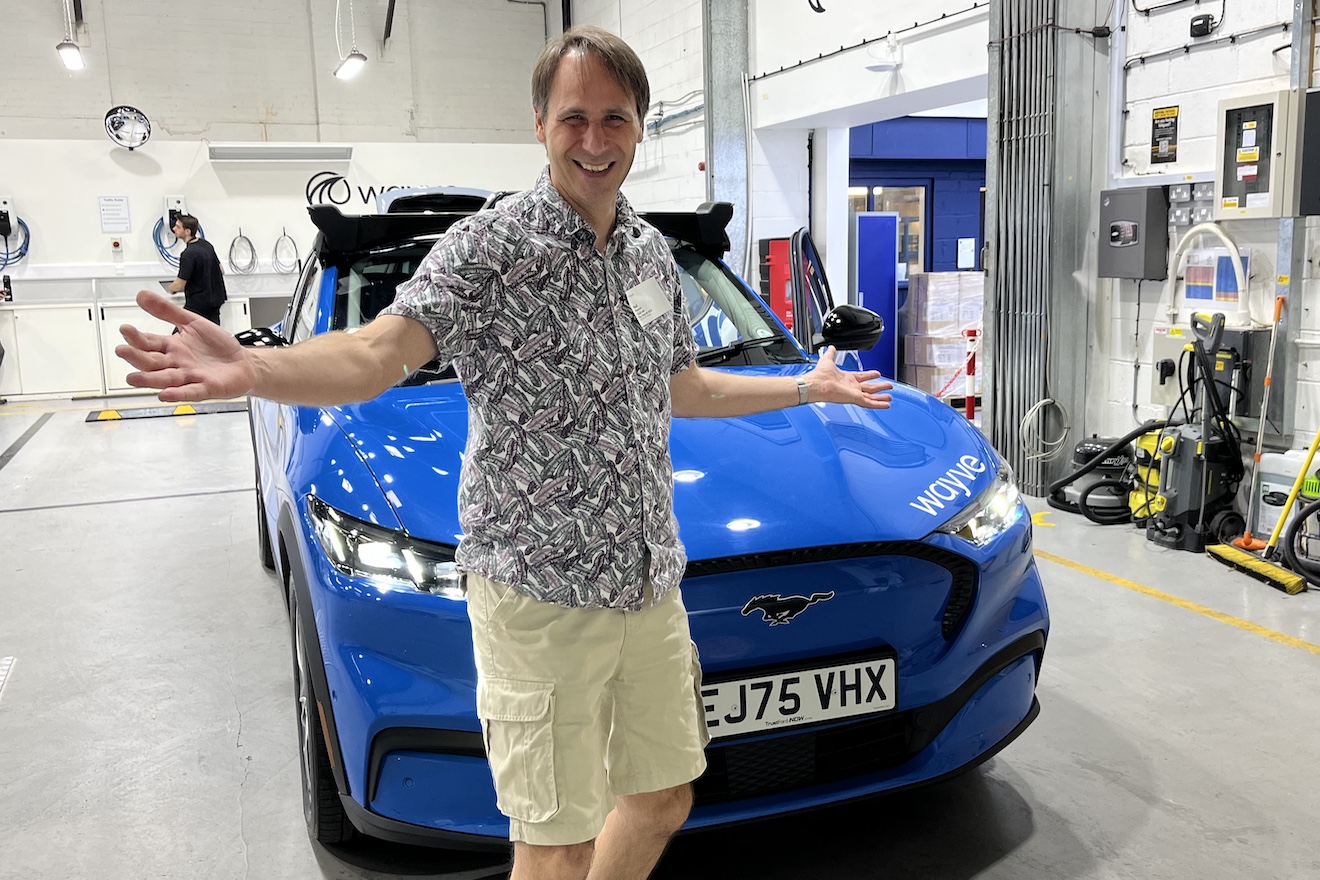
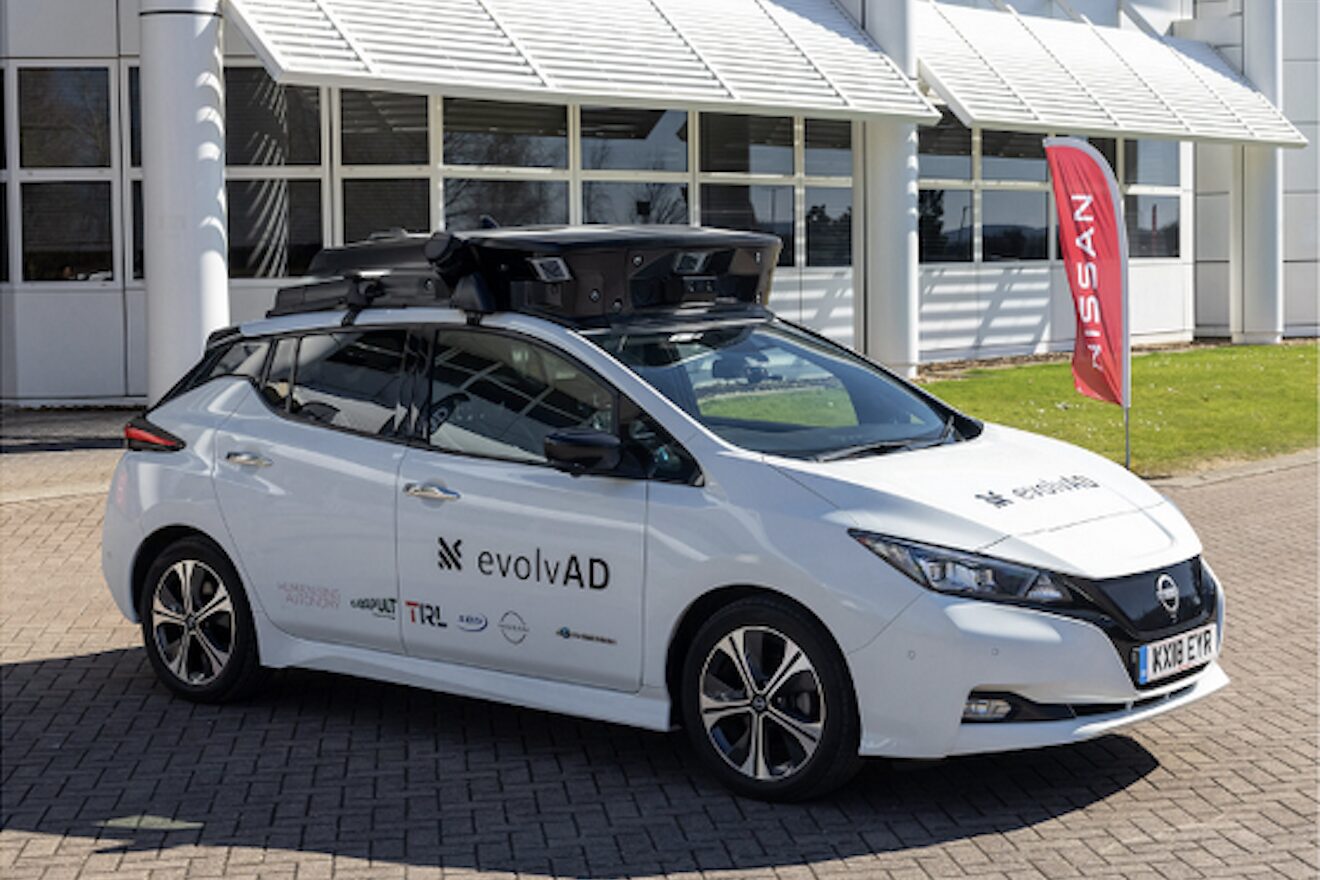
The evolvAD car is kitted-out with 80 sensors, six LiDAR (four long- and two short-range), six cameras on the roof for object detection, plus the outward-looking in-cabin camera for ADAS from the production model.
Two of the roof cameras are designed specifically for traffic light situations – one with a wide lens for when the car is at the front, first to go, the other looking as far ahead as possible to inform stopping distances.
There are two antennas for GNSS positioning, all linked to computers cooled by the vehicle’s air con.
On the software side, there’s an urban stack, with the ability to wirelessly connect to infrastructure cameras, so it knows what’s ahead and can plan accordingly, but the car we rode in had the rural stack, optimised for higher speeds and grip. Soon, they’ll be combined.
“The infrastructure connection is very powerful,” said Shah. “But the rural stack drives more confidently, controlling the braking force at each wheel to deliver a much more dynamic ride. That’s essential to deal with all the cambers, undulations and potholes around here.
“We collect a lot of data and simulate a lot of scenarios. We also do real-world testing at proving grounds such as Millbrook, including failure mode testing where we inject a fault to see if the vehicle responds as we expect it to.”
Self-driving interactions
During thousands of hours of testing, the team have witnessed all kinds of, er, interesting interactions.
“Some people think that it’s a police car and slow down, or a mapping car they might give a hand gesture to,” laughed Shah. “If they realise it is autonomous, they sometimes honk and try to encourage the safety driver to wave.
“We see the politeness of British people, for example, the flashing of lights to let somebody go. That’s something we need to address, in the sense that the public need to be educated that autonomous cars won’t react to that, because it’s not part of the highway code.
“Similarly, the AD car will go at 30 in a 30, not 33, and 20 in a 20. We’ve had somebody overtake us, gesticulating wildly, because we were doing exactly 20mph in a 20mph zone.
“We’ve come a long way from the early days when the software was a bit like a learner driver. Now it drives according to UK norms, with more assertiveness than they need in Japan or Silicon Valley. In London especially, if a pedestrian sees a gap they will just walk.
“The vision of the evolvAD project is to deliver connected and autonomous cars capable of driving in a wide range of environments. The challenges of operating in European rural areas are very different to cities, with a huge diversity of road structures, conditions and traffic types.
“We sometimes have to maintain quite high speeds to keep-up with traffic without becoming a hindrance. We believe we are the first and currently only AD vehicle that can do that.
“Particularly in areas where public transport has declined, we intend to offer a new, alternative, commercially viable means of transporting people and goods.
“There will be competitors trying to do similar, and that’s why ride comfort is key. We want people to choose Nissan because they know they’ll have a safe, comfortable journey, and get to their destination on time.”
Supported by the UK government’s Centre for Connected and Autonomous Vehicles (CCAV), Innovate UK, Zenzic and TRL, the £3.5m evolvAD project has now been extended “To provide critical insights to policymakers and urban planners to ensure a successful introduction of AD mobility services in the right way and at the right time”.
Nissan announced last year that it plans to offer this in Japan from 2027. After playing such a pivotal role in R&D, we eagerly await news of the UK launch.
Please note: a version of this article was first published in the Institute of the Motor Industry’s MotorPro magazine.