Providing self-driving news since 2019, Cars Of The Future is a trusted source on global and UK autonomous vehicle (AV) manufacturers. Leading autonomous vehicle companies include robotaxi providers such as Waymo and Zoox, household name carmakers like Hyundai and Nissan, and autonomous driving stack and sensor technology partners, including Bosch and NVIDIA.
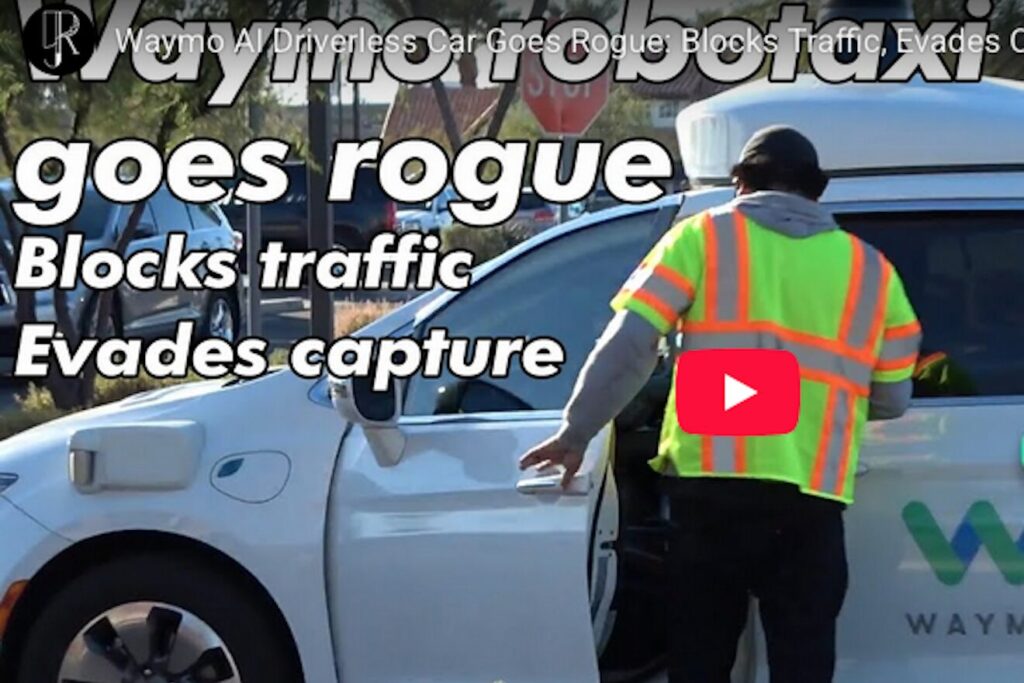
Backed by Alphabet’s resources (annual revenue estimated to be over US$400 billion in 2025), Waymo (formerly the Google Self-Driving Car Project) stands out as a global leader in robotaxi manufacturing. Its Waymo One fully driverless ride-hailing service is already completing over 250,000 paid rides a week in the US, in cities including Phoenix, San Francisco, Los Angeles and Austin – extensive real world experience!
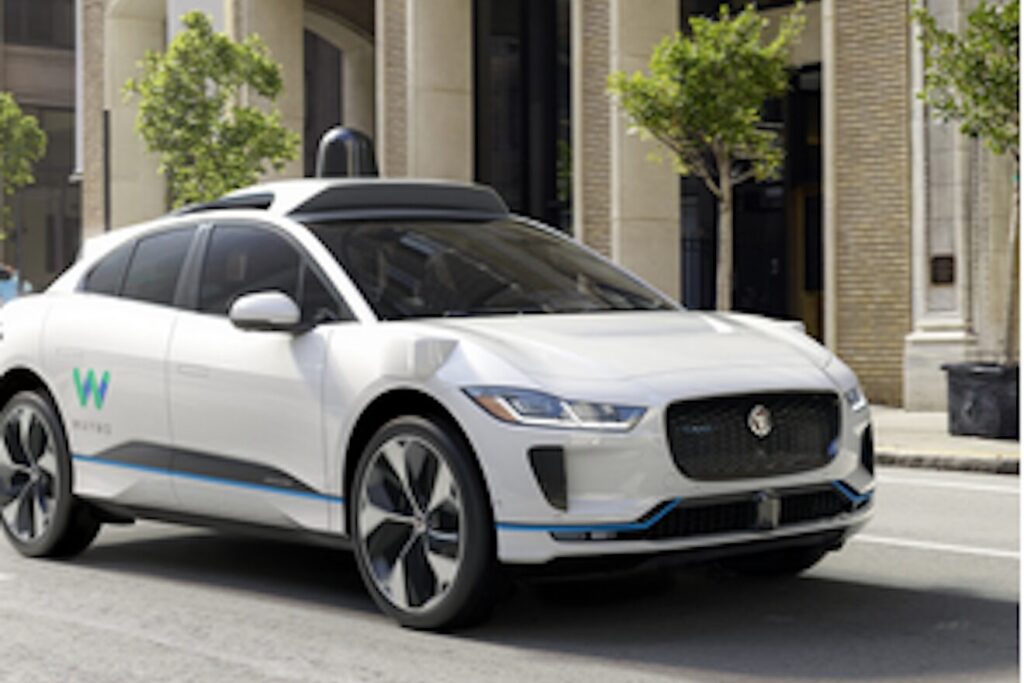
Waymo’s fleet already consists of more than 1,500 vehicles ahead of planned expansion into major cities such as London. Many of these are Jaguar I-PACE cars fitted with the Waymo Driver software and hardware suite, including lidar, radar, cameras, custom maps and artificial intelligence (AI). Designed in the UK, from 2018-24 the I‑PACE was built in Plant Graz, Austria, by Magna Steyr.
More recently, Waymo entered into a strategic partnership with Hyundai to integrate its tech into Ioniq 5 robotaxis. Waymo won our inaugural prize for Consumer Service at the Self-Driving Industry Awards (SDIA) 2024.

Part of Amazon (annual revenue US$637 billion in 2024) since 2020, Zoox, Inc. was one of the first robotaxi companies in the world to offer autonomous vehicle test rides on public roads. Founded by Tim Kentley-Klay and Jesse Levinson in 2014, it had a working prototype within a year.
A pivotal moment came in 2019 with the appointment of Aicha Evans as CEO. On 26 June 2020, Amazon and Zoox signed a merger agreement, under which the former acquired Zoox as a wholly owned subsidiary for the princely sum of $1.2 billion. With its own assembly line in California, December 2020 saw the unveiling of Zoox’s purpose-built, fully autonomous, bidirectional shuttle, known colloquially as “the toaster”.
With no steering wheel or driver’s seat, this four-seater automated pod was a major statement of intent – the stark difference in appearance also signalling a different approach to rival operators using adapted versions of existing passenger cars.
While it looks nothing like a traditional car, the toaster still features components and systems by stalwart automotive Tier 1 suppliers – batteries by Panasonic and an NVIDIA computing platform. Zoox has now expanded its testing operations to Seattle, Las Vegas, Austin and Miami.
Other notable robotaxi operators include Motional, a joint venture between Hyundai Motor Group and automotive technology supplier Aptiv. Founded in 2020 and headquartered in Boston, Massachusetts, Motional’s stated mission is “making driverless vehicles a safe, reliable, and accessible reality”. Operating in Singapore, Las Vegas and Los Angeles, it has partnerships with ridesharing companies Lyft and Uber. Naturally, it also uses modified Hyundai IONIQ 5 autonomous vehicles.
Often referred to as China’s Google, Baidu Inc (estimated annual revenue in 2024 of $18.24 billion) operates the Apollo Go ride-hailing service. It also has partnerships with Uber and Lyft. Its Apollo RT6 autonomous vehicles are manufactured in China by Jiangling Motors Corp. Baidu also uses NVIDIA DRIVE, with QNX providing the ASIL-D safety operating system for the Apollo platform.
In 2017, former Chief Scientist at Baidu, Tony Han, founded a new robotaxi company: WeRide. In 2025, WeRide launched the Robovan W5 and announced a driverless shuttle partnership with Renault Group.
For a short time, General Motors was the market leader in robotaxis with its Cruise brand. However, following an incident in October 2023, the California Department of Motor Vehicles suspended their autonomous testing permit. Co-founders Kyle Vogt and Daniel Kan departed. Not so super cruise.
With their expertise in software defined vehicles and advanced sensors, brand company carmakers like BMW, Mercedes-Benz, Nissan and Tesla are also developing increasingly sophisticated Advanced Driver Assistance Systems (ADAS) and Conditionally Automated Driving Systems (CADS), as well as full ADS.
In 2023, the UK Department for Transport approved the use of Ford’s BlueCruise advanced driver assistance system on parts of the country’s motorway network. It was a momentous moment – legalising hands free driving in the UK for the first time.
Widely respected in L2 driver assistance, with its Highway Assistant, BMW ag has described the technological leap to Level 3 autonomous driving as “very challenging”. In Germany, it has approval for its Personal Pilot L3 enhanced driver assistance system. It has also been collaborating with Valeo on higher level autonomous vehicle technologies, including L4 parking solutions.
Known for its L3 conditionally automated Drive Pilot system, in August 2024, Mercedes-Benz become the first international personal vehicle maker to obtain approval for L4 testing automated driving in the dense city environments of Beijing. This advanced testing aimed to “explore cutting-edge technology in developing automated driving system software and hardware”.
The UK’s Nissan Technical Centre Europe takes a leading role in AV testing – both highway and off-highway, and at higher speeds. EvolvAD by Nissan won Project of the Year at SDIA25, demonstrating expertise in both rural locations (handling roads with potholes and no lane markings) and more complex urban environments (including those with mini-roundabouts).
As one of the leading companies in hands free driving, Tesla is often mentioned in relation to AV manufacturing. In 2021, Elon Musk employees criticised the decision to pursue a vision based system (a camera based system backed by AI) over the full sensor redundancy approach (including radar sensors, lidar and ultrasonic) adopted by other VMs. As of early 2026, its Full Self-Driving (FSD) beta programme remains classified as L2 driver assistance, which, importantly, still requires active driver attention.
With hands off R&D at its Toyota Research Institute, in 2024, Toyota Motor Corporation (annual revenue over US$300 billion that year) and Waymo reportedly agreed to explore a collaboration focused on accelerating the development and deployment of autonomous driving technologies.
Volkswagen AG (VW AG) owns or part-owns around 350 other brands, including Audi, Bentley, Bugatti, Cupra, Lamborghini, Porsche, Seat and Skoda. The group is intensifying its focus on autonomous driving, currently developing an L4 version of its multi-award-winning Buzz van.
In the freight sector, again, we find partnerships involving big-name heavy goods vehicle (HGV) manufacturers, Tier 1 suppliers and hands off technology companies.
In America, Aurora has added its Aurora Driver hardware and software to existing Paccar and Volvo trucks, while Kodiak Robotics has partnered with Bosch, NVIDIA and NXP. Kodiak won the Testing Award at the first ever Self-Driving Industry Awards in 2023.
Co-founded in Silicon Valley and China, Pony Ai has developed self-driving cars using the NVIDIA DRIVE platform, and is partnering with Dongfeng on autonomous trucks.
A leading European manufacturer is Stockholm-based Einride. With technical partners including Nvidia, Bridgestone, Ericsson and Siemens, its trucks are entirely ‘cabless’.
In the bus sector, a partnership between Alexander Dennis and automated drive system provider Fusion Processing has twice won our headline Vehicle of the Year Award, most recently for the Enviro100AEV in 2025. Designed and built in the UK, two of these buses will go into service as part of The Connector project in Cambridge.
Only the second ever category winner to retain their title, we presented our 2025 Testing Award to Karsan. Having developed the first Level 4 autonomous bus to carry ticketed passengers in open traffic, they received the cherished KBA approval in Germany, and became a key partner in ALBUS, one of the world’s largest autonomous bus projects.
Leading autonomous vehicle companies in the UK include Aurrigo, Ohmio, Oxa and Wayve.
Oxa (previously Oxbotica) collaborates with Bradshaw Electric Vehicles, eVersum, Beep, Ford, Bayanat and NVIDIA. Oxa’s Professor Paul Newman CBE was named Industry Legend at the inaugural Self-Driving Industry Awards.
Ohmio won Vehicle of the Year at SDIA24 for its LIFT shuttle, offering demonstration rides in the car park at the Turner Contemporary in Margate. It was also one of the first in the UK to offer on-highway test rides, in the tech hub of Milton Keynes.
Also in 2024, London-based Wayve raised $1.05bn from investors including Softbank, Nvidia and Microsoft. Alex Kendall of Wayve was named SDIA Person of the Year 2023. The company has since announced partnerships with Uber and Nissan.
The line between autonomous vehicles, robots and drones is getting increasingly blurry. EHang made headlines for its electric vertical take-off and landing (eVTOL) aircraft – widely described as a passenger-carrying drone.
In the industrial sector, Hutchison Port of Felixstowe is running autonomous trucks from Shanghai Westwell Technology.
Coventry-based Aurrigo has pivoted from designing products for carmakers such as Aston Martin, and Bentley, to building the autonomous Auto-DollyTug baggage handling vehicle for airports.
Starship Technologies won the inaugural Fleet Operator prize at SDIA25 for its small delivery robots. In a world first, the event saw a Starship delivery robot use the automatic access ramp to board an autonomous Ohmio LIFT shuttle. Autonomous vehicles and robots interacting!
To safely navigate complex environments, virtually all players in the advanced driver assistance and fully autonomous vehicle sectors enter into strategic partnerships with established technology suppliers. From software and services engineering, to simulated testing, and purchasing and supplier networks, welcome to the complex world of the global automotive supply chain!
Companies that provide finished components or systems to vehicle manufacturers are known as Automotive Tier 1 Suppliers. Bosch is the largest. Other Tier 1 giants include Denso, Continental, Magna and Nvidia.
NVIDIA is a global leader in autonomous vehicle development, delivering the AI computing infrastructure that underpins many platforms. Magna provides ADAS and ADS as a Tier 1 supplier, and complete vehicle assembly services via its Magna Steyr division.
Mercedes-Benz Group AG (formerly Daimler-Benz) has partnered with Chinese AI specialist Momenta to develop a L4 autonomous technology. Interestingly, Bosch invested $500 million in Momenta in 2021, and it now also works with automakers GM, Toyota and BYD on perception and mapping.
Autonomous driving company Mobileye – acquired by Intel for $15.3 billion in 2017 – offers the Mobileye chauffeur platform. It acts as a Tier 1 supplier to OEMs like Geely, and as a Tier 2 supplier to ZF, Valeo, and Aptiv.
Looking ahead, autonomous vehicles are set for rapid integration, fuelled by advances in future electric models. Capability overstatement remains a concern and cars with ADAS must not to be confused with fully driverless vehicles. Safety and transparency will be key to gaining all our trust.
Signup for free weekly self-driving news!